|
The Opera & Oratorio Versions
of the Edison Class M/E
by Aleksander Witkowski
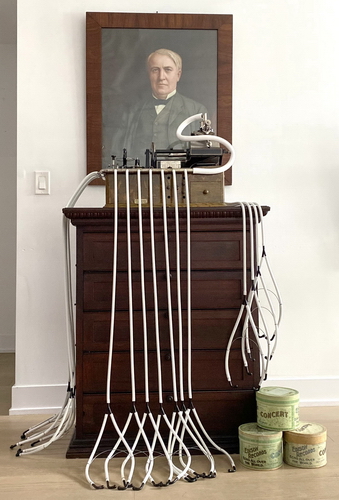
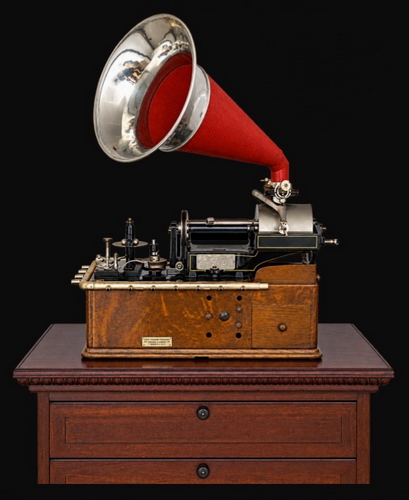
The Edison Class E Oratorio Phonograph is one of the
rarest Edison models ever made. For more than 30
years, this Class E was a cornerstone of the iconic
Domenic DiBernardo collection. While it has recently
moved into new hands, it continues its legacy as a
local treasure, preserved in the city of Toronto.
Edison Class E Oratorio Phonograph
|
|
Manufactured in 1899, this phonograph is the rarest
concert version and features a scarce Bettini reproducer and a listening rail that can accommodate up to 19
listeners, an exceptionally unusual combination of
premium accessories that makes this machine unique.
|
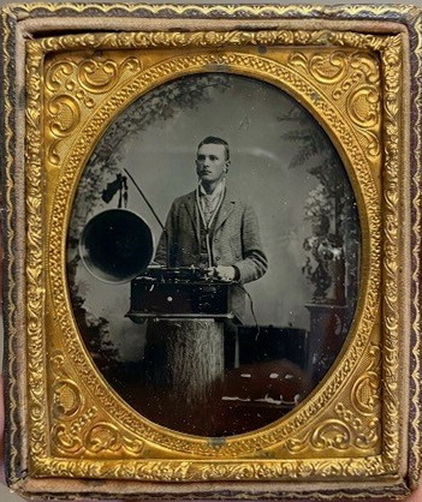
A rare early tintype photograph from the late Allen
Koenigsberg collection. The Edison Class M and Class E
were frequently used and modified for exhibition
purposes.
The machine pictured features remnants on its trim and
upper case where it was cut to display a larger horn
suspended by a front-mounted crane.
|
|
|
The "Opera" & "Oratorio" phonographs are special
variants of the Edison Class M’s and E’s, designed
specifically for playing the large-format concert size
wax cylinders. These cylinders, with a diameter of 5”,
offered significantly greater volume and an extended
frequency range compared to standard cylinders. Their
larger diameter resulted in a higher linear speed of the
stylus along the groove, which made them ideal for
high-quality music and vocal performances.
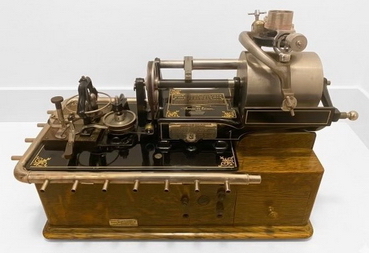
Edison Class E Oratorio,
with listening rail and
Bettini aftermarket reproducer
|
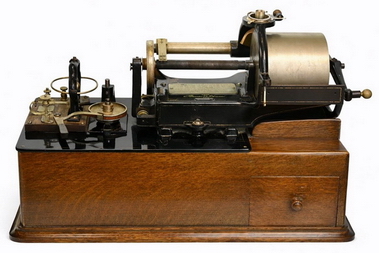
Amazing all Original Edison Class M Opera.
Courtesy of The Edisonium Museum, Rolf Kramer, Austria
|
|
The Class M concert
version was marketed as
the Opera, retailing for
$85 while the Class E
concert version was
marketed as the Oratorio
and retailed for $100 in
late 1899 and early
1900. In general
appearance and equipment, the class E
phonograph is very
similar to the Class M
model. However, it is
uniquely furnished with
an electric motor
specifically wound to
operate on 110 to 120-
volt Edison direct current,
eliminating the need for
the messy batteries that
are required for the Class
M.
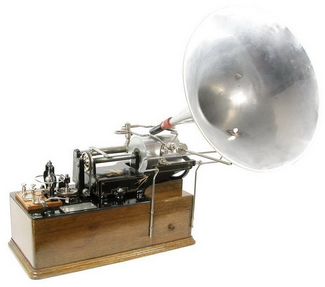
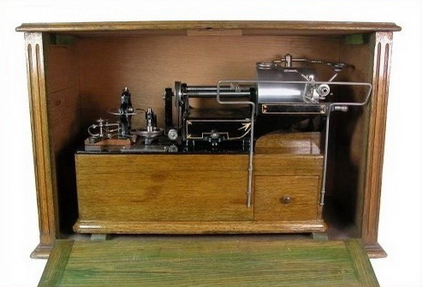
This Edison Class M Opera was factory modified by
Pathé to equip it with the large Vérité system
allowing the use of a floating reproducer and a
removable concert mandrel. Not being able to
completely produce its own phonograph with an
electric motor, at least for a competitive
manufacturing price, the Chatou firm resorted to
this adaptation in order to offer its customers this
electric version of the Concert or Stentor.
|
|
|
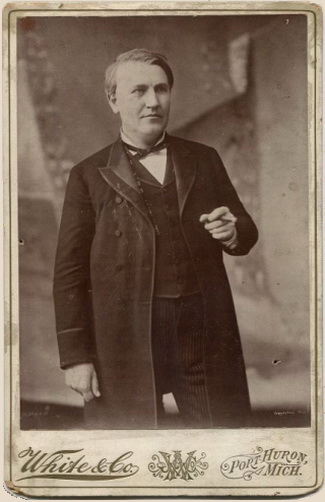
My personal favorite cabinet card picturing
Thomas Alva Edison standing with his cigar.
J.M.White & Co 1102 Military Street,
Port Huron, Michigan.
Courtesy of Chad Shapiro, Baltimore, USA
|
|
According to historical
records, this particular
class E was originally
sold in Toronto, Ontario,
Canada by the R.S.
Williams Company, a
prominent Edison dealer.
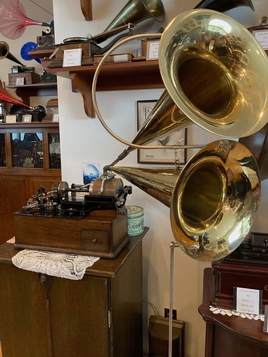
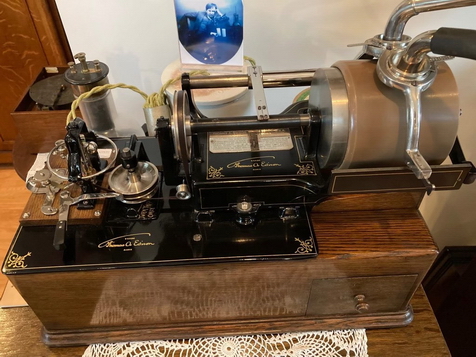
Edison class M Opera with aftermarket
polyphone attachment.
The polyphone attachment is a rare late-
19th-century accessory created by the
Chicago Talking Machine Company that
uses dual reproducers and dual horns
to play the exact same cylinder record
groove simultaneously.
By positioning the two styli roughly half
an inch apart, the device creates a
fractional time delay between the
reproducers that results in a natural,
acoustic reverb. Introduced around
1898, it originally cost $15 for standard
models and $25 for concert versions.
Invented by Leon Douglass, the
Polyphone attachment successfully
doubled the volume of faint brown wax
records and produced a fuller sound.
However, the device became obsolete
around 1902 when louder, mass-
produced molded cylinder records
entered the market.
Courtesy of Henk & Irene Noordermeer,
Ontario, Canada
|
|
|
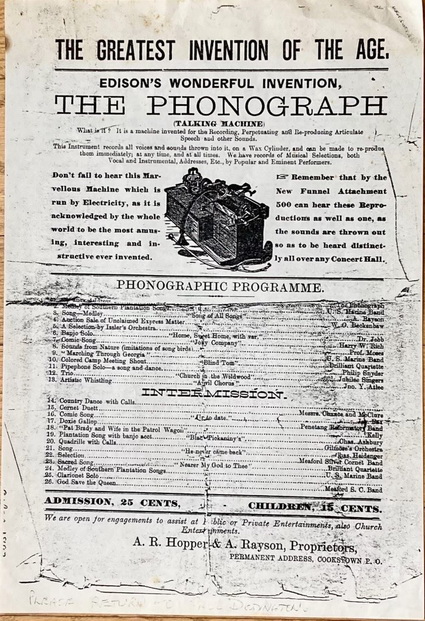
An incredible piece of Canadian
advertising measuring
approximately 8” X 11.5".
A.R. Hopper & A.
Rayson, Proprietors from
Cookstown, Ontario, seeking
engagements to play their Edison
Class M Phonograph for private
entertainments, also church
entertainments.
There is so much intriguing
information that I encourage you
to carefully read through the ad.
Notice the program selection
includes recordings from the
Penetang Reformatory Band
(local prison) and the Meaford
Silver Cornet Band, (a town on
Georgian Bay Ontario).
Maybe you may recognize some
of the other performers as
Canadian recordings while others
are obviously recordings from
Edison or Columbia.
Courtesy of Paul Dodington,
Ontario, Canada
|
|
From the photos stored
with this machine and
Domenic’s notes, it is
safe to say this was a
real barn find. Although
there is no indication as
to where it was found,
the notes indicated that
it was in terrible condition, completely battered
and worn down, covered
in dirt, with the green oak
cabinet painted over with
dark paint or shellac.
Domenic’s expertise in
cabinet refinishing
brought the woodwork
back to its original colour
and condition. Thankfully, untouched patches of the original finish on the front drawer panels guided his meticulous restoration.
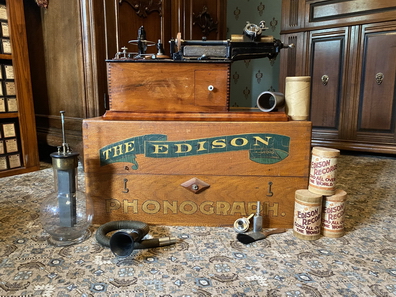
Class M Carnival Exhibition Unit
This impressive Class M Edison
Phonograph was once a hard-
working carnival exhibition unit.
Found with its mahogany cabinet
wrapped in red fabric secured by
nails, and suffering from a burned-
out motor, it has now been
beautifully brought back to life.
Today, it is proudly exhibited at a
historic estate.
Back in the day,
these iconic machines were widely
used for exhibitions, carnivals, and
special events. This specific unit
features a custom-made, period-
correct wooden carrying case
adorned with a gorgeous gold,
green, and blue banner that reads
The Edison Phonograph.
Courtesy of Tim James Pirochta,
Michigan, USA
|
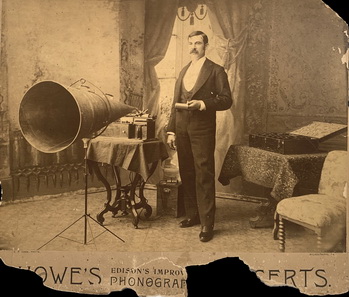
This original 1890s photograph captures Lyman
Hawkes Howe, a foundational figure in early acoustic
entertainment posing with
his Edison Class M phonograph.
During this era, traveling exhibitionists toured
the country, introducing
spellbound audiences to recorded music and spoken-
word comedy for the very
first time. To make these
experiences more personal,
exhibitioners frequently recorded local singers in each
town and added them directly into the evening's program. Today, the rare surviving wax cylinders found in
these traveling kits offer historians a priceless, auditory
window into the forgotten
local performers of the late-
19th century.
Caches of these types of early acoustic recordings have
been found in Canada and are currently being researched. Once fully archived, they will ultimately be made available to the public, offering an unprecedented look at the very dawn of Canadian recorded sound. Progress on this
research will be posted in an upcoming issue of the APN.
Courtesy of Mark Caruana-Dingli, Ontario, Canada
|
|
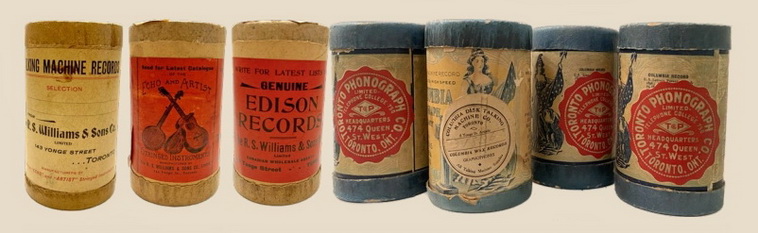
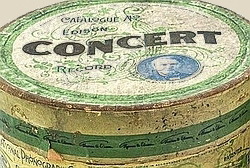
A selection of exceptional
R.S Williams cylinders boxes sold
by the same dealer as the Edison
Class E & Class M phonographs
|
|
Class E phonographs were originally designed to operate on 110 volts DC, which is the reason there are three
terminal posts on the front of the case. Some individuals may be suspicious of the extra holes that can be seen on
the front and back of the cabinet, but those are actually original ventilation holes. These primitive motors are prone to overheating, so these holes were installed to help keep the motor cool.
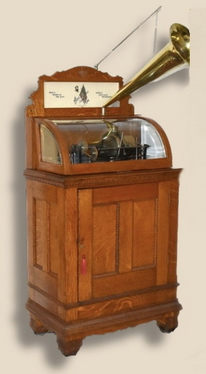
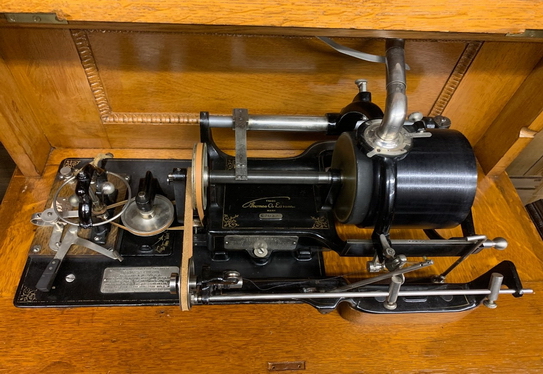
Both the Edison Class ‘M’ Concert battery powered phonograph and
Class ‘E’ Concert 110/120V D.C. phonograph came in electric coin-slot
versions. As D.C. “household” current was not common, the battery
powered version was more successful.
The Class ‘M’ Concert electric coin-slot phonograph (shown) was
marketed as the Ajax while the Class E Concert was given the name
Vulcan.
Outfitted to play the newer Concert-sized cylinders, these machines
produced enough volume to fill a room using large external horns. By
contrast, the quieter, standard-sized brown wax cylinders required the use
of individual listening tubes in the phonograph parlors that sprang up
during this early period.
|
|
Just as the Opera and Oratorio represent the rarest Edison phonographs, these machines stand as the technical
pinnacle of the Class M/Class E line. Due to an exceptionally brief production run cut short by the rapid decline of
the concert cylinder format, only a handful of the Class M Opera version survive today. As for the Class E version,
I’ve only been able to confirm five examples of the regular non-concert type, with remarkably no two being alike;
these range from coin-operated models to units integrated into desks with cast-iron legs. As for the Class E Oratorio
concert phonograph, it appears that this is the one lone concert example known.
|
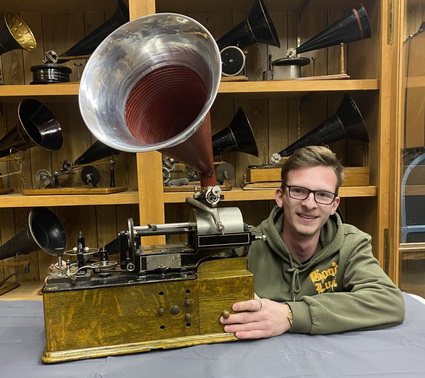
Author Aleksander Witkowski poses
with the Edison green oak Class E
phonograph
|
|
|