|
Made in Canada:
The Pollock-Schröder Connection 1907-1909
by Bill Pratt
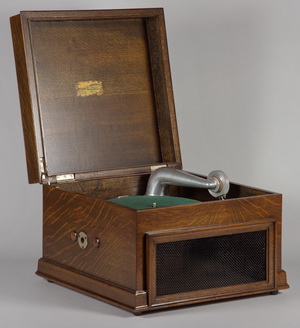
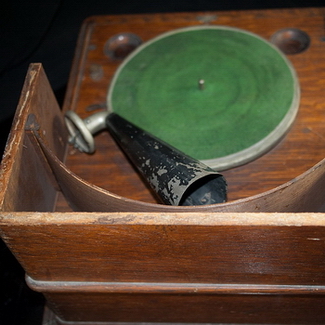
Pollock Hornless Phonograph,
Patent June 4, 1907.
Catalogue Number 2007.031.049.
Courtesy of the Region of Waterloo
Museums & Archives
|
|
In the Autumn 2023 issue of Antique Phonograph News, I documented my discovery of what is, to date, the earliest known talking machine manufactured in Canada—the Canadian Talking Machine, produced in London, Ontario, beginning in mid- to late 1898.
The second Canadian-made talking machine was the Berliner Gram-o-phone, first manufactured in Montreal, Quebec, beginning in late 1899.
This article presents research on Canada's third domestically manufactured talking machine: an internal-horn cabinet model patented on June 4, 1907, and produced by Arthur B. Pollock of Berlin, Ontario.
The first mass-market home talking machine to conceal its horn within a wooden cabinet was the Victor-Victrola—specifically the upright VTLA model, which employed the Pooley cabinet covered by U.S. Design Patent No. 38,113, issued July 3, 1906. It was marketed to the public by the Victor Talking Machine Company of Camden, New Jersey, beginning in August 1906.
In early advertisements, talking machines in which the sound-conveying passage was concealed within the cabinet were frequently described as “hornless” models. This revolutionary development in record playback technology was noted in Talking Machine World as early as January 1906.
With the frequency which the amplifying horn is referred as an indispensable adjunct in the reproduction of sound by means of the talking machine, news comes that an invention is nearing perfection to supersede the horn entirely. The sanguine prophet of this revolutionary innovation declares that not many moons will wax and wane before the hornless machine will be a practical and commercial success.
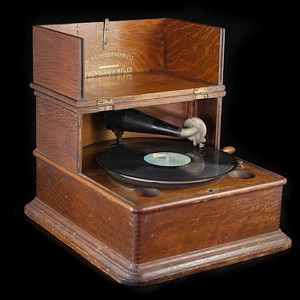
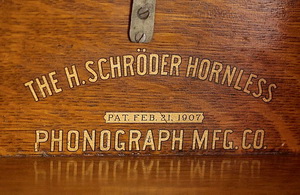
Schröder Hornless Phonograph,
Patent February 21, 1907.
|
|
The Victor-Victrola proved an immediate success.
One of the marked features in machine sales is the astonishing orders placed for Victor-Victrolas, the new hornless combination cabinet product of the Victor Talking Machine Co., who admit their inability to make deliveries as rapidly as might be wished, and possibly prayed for on the part of the jobber. The V. V. has certainly made a "ten strike," and imitations are being heard about in the open market. (TMW, November 1906, p. 33)
Attention within the phonograph industry now shifted increasingly toward cabinet design rather than the pursuit of tonal purity.
Next to the development and improvement in records and machines is the extraordinary demand for artistically designed and beautifully finished cabinets. Scarcely a jobber of any importance but who carries some kind of a line in these goods, and manufacturers are responding to the call for yet finer examples and more ingeniously constructed articles of this kind promptly and with commendable intelligence. Houses famous for these specially elegant and comprehensive line of record cabinets, becoming weary of supplying ideas in connection therewith to the trade at large, are originating entirely new designs, which will be made the subject of patents and thereby relegating them to the realm of exclusive possessions. This is only fresh evidence of trade expansion, and is welcome. In this connection, it may be well to note that a general caution has been distributed concerning the alleged infringement of a hornless cabinet patent, of which doubtless more will be heard in the near future. (TMW, February 1907, p. 31)
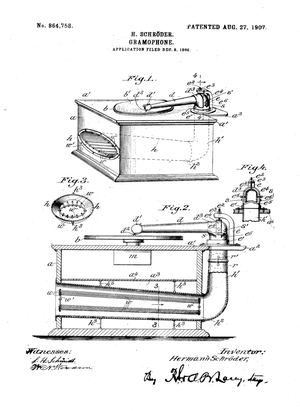
Schröder American Patent No. 864,758.
The illustrations in Schröder Canadian Patent
No. 105,611, issued June 4, 1907, are identical.
|
|
One early imitator—and possible infringer—of the Victor-Victrola internal-horn cabinet design was the H. Schröder Hornless Phonograph Manufacturing Company of 387 East 158th Street, New York City, incorporated on March 3, 1907, with a declared capital of $500,000.
On December 8, 1906, Hermann Schröder, a German citizen residing in Newark, New Jersey, filed a patent application for an internal-horn tabletop phonograph. U.S. Patent No. 864,758 was granted on August 27, 1907. Schröder also sought Canadian protection for his invention, filing on April 8, 1907; Canadian Patent No. 105,611 was issued on June 4, 1907.
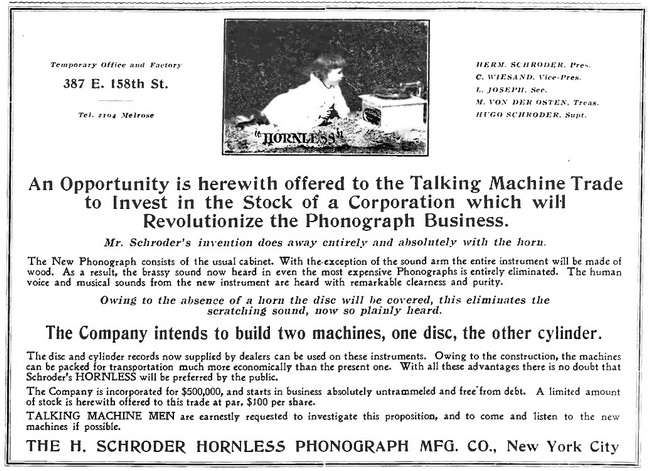
In June 1907, Schröder placed an advertisement in Talking Machine World seeking investors as he prepared to market two "hornless" talking machines—one disc and the other cylinder:
which will possess a number of new and unique features that are bound to at once attract the attention of the trade. Both of these machines are constructed without horns and are made on many absolutely new principles, thus ensuring against any possible infringements on those of any other make. One of the most marked improvements is that of tonal reproduction, all scratching, and harsh, discordant sounds being eliminated. Another desirable feature is that of saving on shipping, as these instruments are built in a most compact manner, and can be packed for transportation most economically.
He asserted that his models would not resemble the Victor-Victrola. Indeed, both the patent drawing and the June advertisement, which featured a photograph of a child seated beside the machine, depict a tabletop hornless design.
Notably, Victor did not introduce a concealed-horn tabletop model until July 1909, with the release of the Victor-Victrola XII. In form, Schröder’s design more closely anticipated the appearance of the lidless Victrola IV or VI—models that would not be introduced until 1911.
Schröder advertised to the trade for investors on the eve of introducing
his hornless talking machine. Talking Machine World, June 1907, p. 51
|
|
Schröder’s advertisement was met with evident enthusiasm by readers of Talking Machine World, prompting him to express his appreciation with a glowing endorsement of the magazine.
We greatly appreciate your publication. One news item which you published regarding our product brought us requests from all over the world. We take great delight in informing you about this for the benefit to us is incalculable. No doubt you are glad to hear that The Talking Machine World is the best medium for all classes of dealers in musical instruments. (TMW, September 1907, p. 30)
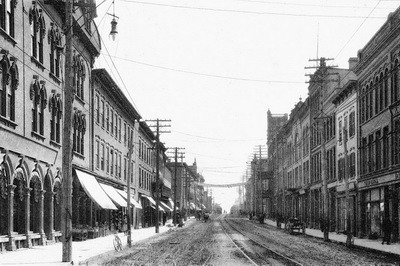
The early story of Pollock and his connection to Schröder begins with a visit to New York City in 1896 by nineteen-year-old Arthur Bell (A.B.) Pollock (1877–1951). Much of what is known about this episode derives from a 1997 book by Raymond Stanton, "Visionary Thinking: The Story of Canada’s Electrohome." Born in Linwood, Ontario, to Scottish parents, Pollock left his position as a bookkeeper in a Berlin, Ontario dry goods store to seek broader opportunities. At the time, Berlin was one of the most active and prosperous manufacturing centres in eastern Canada, located some seventy miles southwest of Toronto and boasting a population of between 10,000 and 13,000 in 1907.
King Street, looking east, Berlin, Ontario
Photogravure published by F.I. Weaver & Co., 1907
|
|
While in New York, Pollock reconnected with two former classmates from Berlin High School who were studying music at the Metropolitan Opera. One of them, Charles Harry Boehmer—who would later achieve international recognition as an operatic tenor—eventually became Pollock’s brother-in-law when Pollock married Rachel ("Racie") Boehmer in Waterloo, Ontario, on September 2, 1902. The other friend was Edward Johnson, who likewise rose to operatic prominence and later served as Dean of the Faculty of Music at the University of Toronto.
Through his associations with Metropolitan Opera singers, A.B. Pollock was introduced to Tennant Putnam, treasurer of the New York Yacht Club and president of the Manhattan Club, two of the city’s most exclusive social institutions. Pollock subsequently became Putnam’s private secretary, a position that brought him into contact with some of the wealthiest and most influential businessmen in New York.
Among them—and of particular importance—was Hermann Schröder, who was attempting to market an internal-horn talking machine but was struggling in the face of strong competition and insufficient capital. When Pollock informed him that no hornless phonographs were then being sold in Canada, Schröder encouraged him to pursue the venture there.
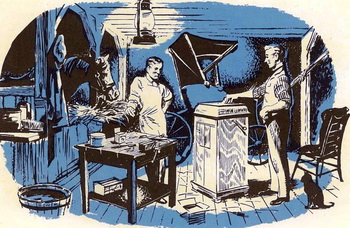
Unattributed illustration from Edna Staebler's 1957 book "The Electrohome Story" shows A.B. Pollock and Alex Welker in the carriage house at 68 Benton Street constructing one of the first hornless phonographs.
|
|
Recognizing the opportunity to establish his own business, A.B. Pollock returned to Berlin in 1906 with a supply of phonograph motors, tone arms, and reproducers obtained from Schröder. Lacking the mechanical expertise to assemble a hornless phonograph himself, he enlisted the assistance of Alex Welker, an engineer who had played a key role in introducing Canada’s first production automobile from a small plant in Berlin.
The wooden cabinets were produced by a local furniture manufacturer, while Welker fabricated the tone arms, reproducers, and wind-up motors in a nearby foundry. Final assembly took place in the carriage house of Racie Boehmer Pollock’s family residence at 68 Benton Street in Berlin.
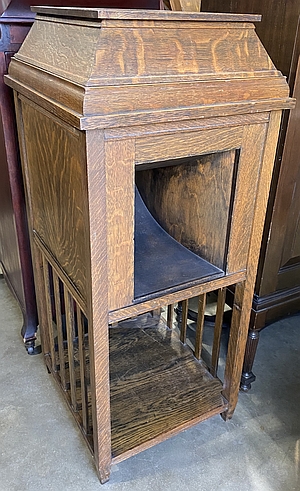
Pollock’s first machine was described as "a tall oak cabinet with a heavy lid over the turntable mechanism and doors at the front which opened to let out the sound." The description bears a striking resemblance to the Victor-Victrola VTLA, and Pollock soon faced a lawsuit from the Berliner Gramophone Company of Montreal alleging infringement of its internal-horn design patent.
Fortunately for Pollock, Berliner was, at that time, importing Victrola cabinets from the Victor Talking Machine Company in the United States rather than manufacturing hornless machines in Canada. As a result, the court ruled in Pollock’s favour, finding that Berliner had not produced a concealed-horn machine domestically within the required twelve months of securing its patent.
Encouraged, it seems, by local interest in Berlin, Pollock subsequently supplemented his original full-sized cabinet model with a tabletop version, "a square, box-like style with a lid."
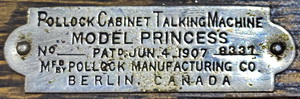
No. 8337 suggests a large production run of the upright Model Princess. A second label on the cabinet identifies the retailer as
R.S. Williams & Sons Co. Limited, Toronto.
Photographs by Alexander Witkowski
|
|
In 1907, Pollock established the Pollock Manufacturing Company, which was formally incorporated on April 21, 1909. The firm initially operated on Victoria Street, later relocating to Breithaupt Street before ultimately settling in the former Malcolm and Hill Limited furniture factory on Duke Street, conveniently situated near the railway line.
Also in 1907, an agreement was concluded between the Schröder Hornless Phonograph Manufacturing Company and the Pollock Manufacturing Company, licensing Pollock to manufacture and sell the Schröder hornless phonograph in Canada. The following year, in 1908, a further agreement was reached between Hermann Schröder and Arthur Pollock, under which the Canadian patent rights were assigned to Pollock in exchange for the payment of royalties on each hornless phonograph produced or sold.
Hermann Schröder was, above all, an inventor. Between 1906 and 1908, he filed eight patent applications. Following his foundational patent for the internal-horn cabinet (U.S. Patent No. 864,758, issued August 27, 1907), his second patent (No. 884,216, issued April 7, 1908) addressed improvements to the mechanism of the cylinder phonograph. Its principal objective was to employ a stationary needle or stylus while the cylinder record revolved longitudinally beneath it. A well-known example of this principle in practice was the traversing mandrel mechanism employed in the Edison Amberola model (A)-1, introduced in late 1909.
In Patent No. 890,534 (issued June 9, 1908), Schröder—by then listed as a citizen of the United States residing at 105 Mt. Hope Place in the Bronx, New York—described refinements to the internal horn intended to produce a mellower tone and to eliminate the objectionable metallic quality often associated with earlier designs.
Patent No. 891,378 (issued June 23, 1908) addressed improvements in the horizontal movement of the tone arm in disc talking machines. This was followed by Patent No. 895,900 (August 11, 1908), which proposed further refinements to the internal horn aimed at improving tonal quality.
Schröder’s inventive activity was not confined solely to the machines themselves. Patent No. 909,461 (January 12, 1909) detailed improvements in the construction of disc records, introducing a method of making them lighter, less expensive, and more resistant to breakage under hard use. Patent No. 912,625 (February 16, 1909) described new and useful improvements in spring-motor construction. Finally, Patent No. 919,252 (April 20, 1909) returned to the subject of the internal-horn cabinet, setting forth additional structural enhancements.
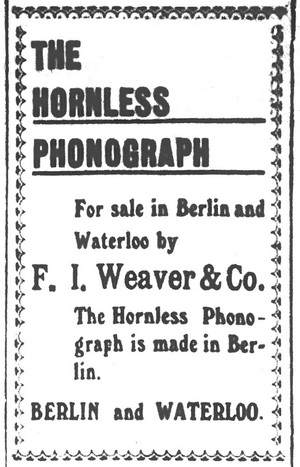
First ad for the Hornless Phonograph.
Berlin Daily Telegraph, March 25, 1908, p. 6
|
|
Schröder's strengths lay in invention rather than in manufacture, marketing, or sales—despite the confident report in the June 1907 issue of Talking Machine World, which stated: "The Schröder Co. intend to devote their entire time to manufacturing, and will appoint a number of large firms as sole agents, who in turn will establish jobbers in various parts of the country for the purpose of pushing their line among the dealers."
In this respect, he found an ideal counterpart in A.B. Pollock, whose abilities were more entrepreneurial than technical. Notably, Schröder does not appear to have advertised his hornless talking machine in the United States. A comprehensive review of American newspaper advertisements from 1907 to 1912 has failed to produce a single example of a Schröder advertisement in the U.S. market.
In January 1909, Schröder placed a modest display advertisement in Talking Machine World announcing:
WANTED AT ONCE, A Jobber in every State of the Union as Exclusive Wholesale Agent for THE SCHRODER HORNLESS DISC PHONOGRAPH. For Further Particulars Address The H. Schroder Hornless Phonograph Mfg. Co., Inc., Office and Factory: 387 East 158th St., New York.
The notice suggests that, rather than presiding over an established and thriving manufacturing operation supplying the American market, Schröder was still in the preliminary stages of organizing distribution. As of early 1909, his enterprise appears to have been in its formative phase rather than fully operational.
In October 1912, Talking Machine World published a brief notice under the heading "Looking for New Factory Site":
According to reports the H. Schroeder [sic] Hornless Phonograph Co. is looking for a suitable factory site and is considering Fairground, N. Y., as a possible location. The company claims to have $500,000 capital and expects to employ 200 people or more at the start. The headquarters of the company are in New York. H. Schroeder is well known as an inventor in the talking machine field and for some time had a small experimental and manufacturing plant in the Bronx.
As late as 1912, Schröder appears to have remained primarily engaged in experimental work on phonograph design, likely producing only a limited number of prototype machines. He had not yet established a substantial factory capable of large-scale manufacture and distribution.
Second ad for the Hornless Phonograph. Berlin News Record, July 13, 1908, p. 6

|
|
Under the 1907 and 1908 agreements, Pollock was licensed to manufacture and sell the Schröder hornless phonograph in Canada in exchange for royalties. Schröder seems to have been content with this arrangement, pursuing his inventive interests while leaving A.B. Pollock to undertake the commercial production and distribution of the hornless phonograph throughout Canada.
F.I. Weaver & Co. was a prominent local firm with branches in both Berlin and Waterloo, Ontario. Though primarily known as a bookstore, Weaver’s inventory ranged widely, including cameras, clocks, toiletries, and even go-carts. On February 27, 1908, the company began advertising Edison phonographs. Less than a month later, on March 25, the first advertisement appeared in The Berlin Daily Telegraph for the Canadian-made, Pollock-manufactured talking machine, described as a "hornless phonograph—made in Berlin—for sale in Berlin and Waterloo at F.I. Weaver & Co." The advertisement was repeated daily through April 6.
On July 13, 14, and 15, Weaver’s Bookstore placed a second advertisement in The Berlin News Record, in which the Pollock machine was described as "the improved hornless phonograph"—wording that may suggest the incorporation of some of Schröder's more recent design refinements. Neither of the early advertisements included an illustration of the instrument.
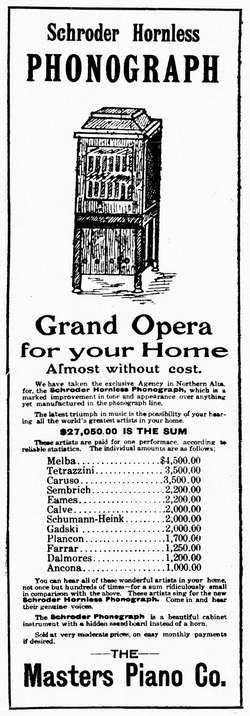
First ad with depiction of the
Schröder hornless phonograph,
"Princess" model. Edmonton Journal,
December 19, 1908, p. 5
|
|
The first advertisement to feature a line-art illustration depicted the Schröder-named hornless phonograph, specifically the upright "Princess" model. It appeared on December 19, 1908, in the Edmonton Saturday News, and simultaneously in the Edmonton Bulletin and the Edmonton Journal. The Master’s Piano Co., located at 236 Jasper Avenue West, was identified as the exclusive agent for the instrument in northern Alberta.
In December 1908, Weaver advertised "records for all kinds of phonographs" and, in addition to the Pollock Hornless, promoted the Star phonograph—an external-horn talking machine—along with Star records. These products were manufactured by the Hawthorne & Sheble Manufacturing Company of Philadelphia.
An article published in the Canadian Music Trades Journal on January 1, 1909, under the heading "Booming the Concealed Horn Machine," reported:
Mr. A.B. Pollock, of the Pollock-Snyder Co., of Berlin, who are specializing in a hidden horn talking machine, has returned from a tour of the Western trade, going as far as the Pacific Coast. Mr. Pollock holds several Canadian patents on inventions of his own in this connection. He reports excellent returns from his trip west, and his firm is now at work on a third model, which with the other productions of the Pollock-Snyder Co. will be illustrated to the trade in the near future. Mr. Pollock, though a Canadian, received his talking machine training in New York, and, returning to Canada, felt convinced of the possibilities for his invention here.
There is no evidence that Pollock held any patents "on inventions of his own." Also, this article contains the only known reference to a "Pollock-Snyder Co." The "Snyder" was likely W. M. Snyder, who in 1904 purchased the assets of the Berlin Piano and Organ Company, which was subsequently acquired by the American firm Foster-Armstrong in 1906.
Although the article stated that Pollock was "at work on a third model," and a report in the Edmonton Saturday News of February 27, 1909, referred to "two sizes and prices, the large which stands on its own base, selling for $95, and the smaller which may be set on any table, at $65," a December 26, 1908 advertisement in the Edmonton Saturday News for the Schröder Hornless Phonograph illustrated the upright "Princess" model, priced at $95.00, and noted two additional styles available at $50.00 and $65.00.
This evidence suggests that multiple models were already being offered by the end of 1908. However, all known newspaper advertisements to date for the Schröder and Pollock talking machines depict only the upright "Princess" model, leaving the appearance of the other styles undocumented.
On March 13, 1909, an advertisement for the Schröder Hornless Phonograph appeared in the Calgary Herald, where it was described as being "Made in Canada." The Alberta Piano & Organ Company was identified as the sole agent for the phonograph in southern Alberta. On that same day, the Edmonton Saturday News carried an advertisement for a Pollock Cabinet Talking Machine—the first known advertisement to include an illustration of a machine bearing the Pollock name.
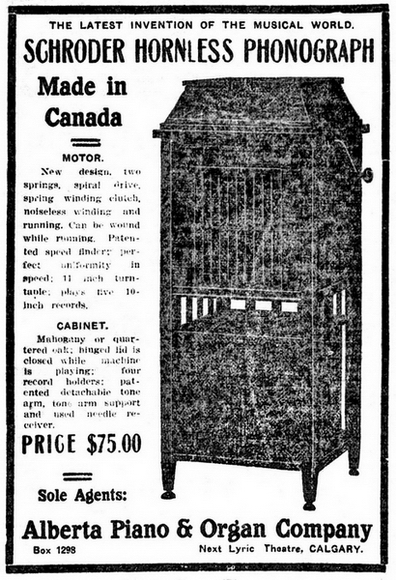
Ad for the Schröder Hornless Phonograph, Made in Canada.
Calgary Herald, March 13, 1909
|
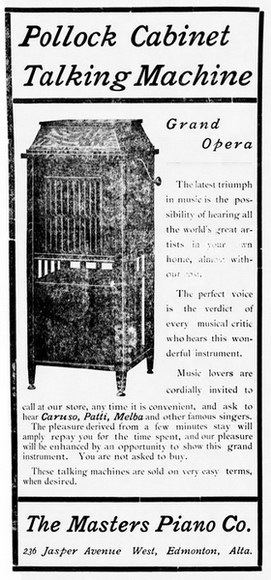
Ad for the Pollock Cabinet Talking Machine.
Edmonton Saturday News, March 13, 1909
|
|
Significantly, both advertisements depicted the identical model: the upright "Princess." Pollock was manufacturing and marketing the same instrument under two different brand names—at times as a Schröder, and at others as a Pollock.
The final Weaver advertisements in Berlin, Ontario, for the Pollock Hornless Phonograph appeared in mid-January 1909. By March of that year, Pollock had transferred distribution of the instrument to George Wanless of the Wanless Music Store, 26 King Street West, Berlin, which promoted itself as the sole agent for Pollock machines and Star records.
On March 10, the "Princess" model was advertised at Wanless’s Music Store as "the coming thing" and "the real thing when it comes to reproduction of the human voice. Come and hear me sing Grand Opera." Wanless subsequently placed advertisements in the Berlin News Record on May 7 and 8 for the Pollock Hornless Phonograph—though without illustrating a specific model—alongside promotions for Star records.
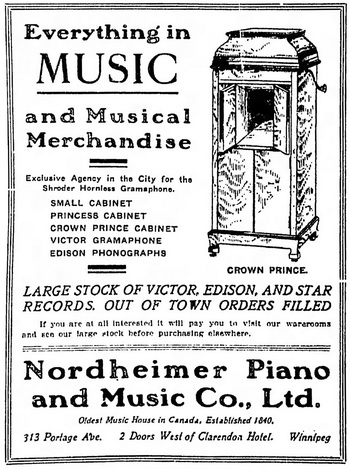
Ad for the Schröder Hornless "Crown Prince" model.
Manitoba Morning Free Press, July 10, 1909, p. 9
|
|
In March 1909, Musical Canada reported that the Bell Piano Company had established an elegant talking machine department on the third floor of its Toronto warerooms at 146 Yonge Street, where it would handle the Pollock hornless cabinet machines. Manager George Sharkey expressed considerable enthusiasm for the new venture and indicated that the hornless cabinets would be featured almost exclusively.
An article published on April 1 in the Canadian Music Trades Journal, under the heading "New Cabinet Talking Machine," reported:
The Pollock Manufacturing Company, Berlin, Ontario, is budding out as an important factor in supplying talking machines for the Canadian trade. They have recently added very largely to their capital, and have completed arrangements for the formation of a joint stock company. For some time they have been engaged in the manufacture of horn machines and after much experimenting, have now perfected a cabinet talking machine which they claim is giving most satisfactory results to their customers everywhere. They will hereafter make a specialty of cabinet machines, manufacturing them in three styles to suit different classes of trade, and are covering the whole Dominion with their product. They have put upon the market some very handsome designs, finished in mahogany or any shade of oak desired. This company are also Canadian distributors of the Star records.
This was the first—and only—reference to "the manufacture of horn machines", meaning external-horn machines, in connection with the Pollock Manufacturing Company, a claim that is not corroborated elsewhere in the record. The notice does, however, confirm that a third cabinet style had been added to the company’s catalogue. This was almost certainly the "Crown Prince" model, first illustrated in an advertisement for the Schröder Hornless Gramaphone [sic] published in the Manitoba Morning Free Press on July 10, 1909. That advertisement listed three available styles: the "small cabinet," the "Princess cabinet," and the "Crown Prince cabinet."
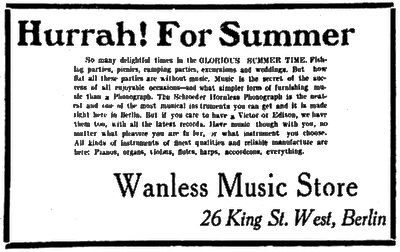
"The Schroeder Hornless Phonograph ...
is made right here in Berlin."
Berlin News Record, June 14, 1909, p. 8
|
|
On May 1, 1909, the Canadian Music Trades Journal reported that the Berliner Gramophone Co. of Canada, Limited, had initiated legal proceedings against the Pollock Manufacturing Company for alleged infringement of its taper-arm patent (No. 103,332), filed April 6.
On June 14, 16, 21, and 22, Wanless advertised the "Schroeder [sic] Hornless Phonograph," describing it as "the neatest and one of the most musical instruments you can get and it is made right here in Berlin" (emphasis added).
The Manitoba Morning Free Press advertisement of July 10, 1909, identified the Winnipeg branch of the Nordheimer Piano and Music Co., Ltd., located at 313 Portage Avenue, as the exclusive agent for the Schröder phonograph in Manitoba. Significantly, this appears to have been the final advertisement in a Canadian newspaper for a Schröder-branded talking machine. Thereafter, all advertisements referred exclusively to the Pollock-branded instrument.
A month later, on August 13, the Berlin News Record noted that the company was "now in its third year," suggesting 1906 rather than 1907 as the effective founding date. The same report observed that the Pollock phonograph was "meeting with great success and was on sale in the leading cities and towns of Canada, from Vancouver to Halifax," and identified the Berlin Interior Hardwood Co. as the manufacturer of the cabinets.
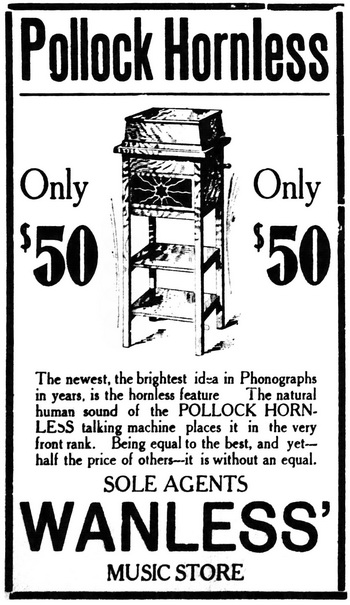
The first illustrated advertisement for the Pollock Hornless "Duke" model appeared on December 1 in the Berlin News Record. The design resembled a tabletop machine adapted into a floor-standing cabinet by the addition of four legs and two shelves. Newspaper advertisements from this period illustrated only three upright models—the "Duke," the "Princess," and the "Crown Prince." However, an advertisement published on April 9, 1910, in Toronto's Globe and Mail referred to "four models in mahogany or oak finished to order if desired." The fourth model was presumably an unnamed and unillustrated tabletop version.
Ad for the Pollock Hornless "Duke" Model.
Berlin News Record, December 1, 1909, p. 8
|
|
On December 1, the Berlin News Record reported under the heading "Another Business Enlarging":
Finding his present premises too small for the increasing demand for his hornless phonographs, Mr. A.B. Pollock has decided to get into larger quarters. The Record learns that he has secured a lease of the old go-cart factory and will shortly transfer his plant to that place and add more workmen.
Yet, as late as May 1910, Pollock had been unable to relocate his machinery owing to the poor condition of Victoria Street, and an appeal was made to City Council for assistance. During this period of uncertainty, no Wanless advertisements for Pollock phonographs appeared during the first six months of 1910.
In February 1910, Talking Machine World reported that the Victor Talking Machine Company had secured a preliminary injunction against the Schröder Hornless Phonograph Manufacturing Company—not on the basis of the internal-horn cabinet design, but for its use of the so-called "mechanical feed" device.
Despite this legal setback, Schröder continued his inventive work. As late as 1921, he patented a new resonance chamber intended to enhance both the quality and volume of reproduced sound in phonographs (U.S. Patent No. 1,395,602, issued November 1, 1921).
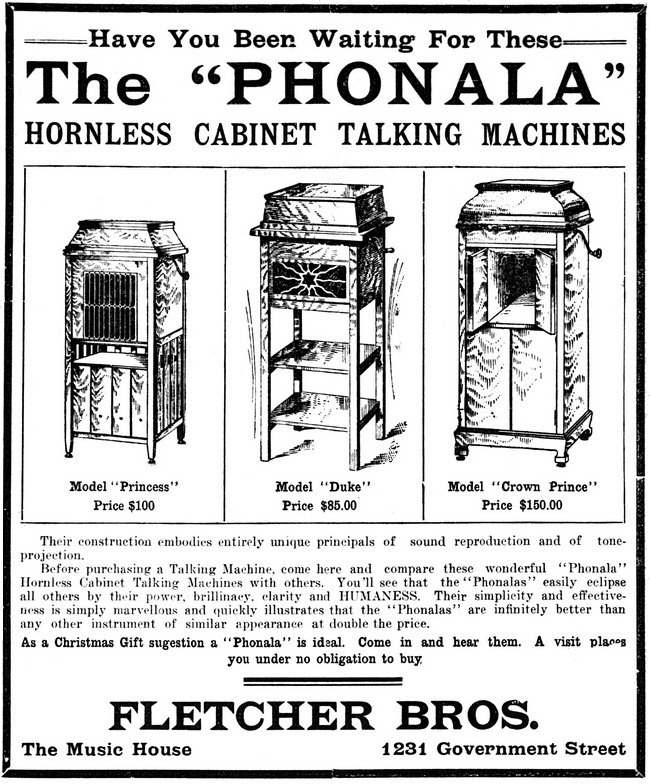
By late 1909, the Pollock talking machine was in need of a distinctive brand name. For more than a year it had appeared in advertisements under various descriptions—the Pollock Hornless Cabinet Talking Machine, the Pollock Hornless Phonograph, or simply the Pollock Phonograph. The company ultimately settled on the name "Phonola," formally introducing it on December 2 in British Columbia through advertisements placed by Fletcher Bros., billed as Western Canada's largest music store.
The launch, however, was not entirely seamless. The Victoria Daily Times misspelled the name as "Phonala" in advertisements for Fletcher’s Victoria location through mid-December, while the Daily News Advertiser correctly used "Phonola" in promotions for the company's Vancouver branch. Western Canadian retailers quickly adopted the new branding, consistently using "Phonola" in subsequent advertisements. In contrast, advertisements in Berlin—where the machines were manufactured—continued for some time to refer to the instrument as the Pollock Hornless.
In 1917, the transition was completed when the company formally adopted the name The Phonola Company of Canada and acquired a woodworking plant in Elmira, Ontario, to manufacture its phonograph cabinets. This facility would eventually expand into a substantial furniture manufacturing enterprise in its own right.
Ad for the newly-named Phonola (misspelled "Phonala") hornless cabinet talking machines.
Victoria Daily Times, December 2, 1909
|
|
In 1925, Pollock and Welker formed a new company, Pollock-Welker Limited, and acquired the factory, plant, and business of the General Phonograph Corp., Ltd., in Kitchener, Ontario (formerly Berlin, renamed Kitchener in May 1916). The acquisition enabled them to continue manufacturing Helycon phonograph motors, tone arms, and reproducers.
That same year, they established the Grimes Radio Corporation to manufacture and market Grimes radios in Canada. In 1929, the company introduced the Pulwel portable phonograph. Finally, in 1933, Pollock consolidated his various enterprises under a single corporate entity, forming Dominion Electrohome Industries Limited.
Notes
Early hornless phonographs manufactured by Arthur B. Pollock bear reference to Canadian Patent No. 105,611, issued June 4, 1907 to Hermann Schröder. This citation clearly identifies the Canadian patent under which Pollock’s machines were produced.
The patent date appearing on the hornless tabletop phonograph manufactured by the H. Schröder Hornless Phonograph Mfg. Co., illustrated in this article, is more problematic. The machine bears the date February 21, 1907; however, a search of United States patent records discloses no phonograph-related patents filed or issued on that date. In the absence of any corresponding American patent, the significance of February 21, 1907 remains uncertain. It may reflect a preliminary application or even a stamping error rather than an official patent issue date.
Despite several newspaper references to a tabletop version, no surviving newspaper advertisement from this early period includes an illustration of the model. It may not have been marketed in western Canada. The first known newspaper depiction of a Pollock tabletop machine did not appear until April 29, 1911, in the Toronto Globe and Mail. The design illustrated there closely resembles the unpopular Victor-Victrola XII, introduced in 1909, with its notably small horn opening concealed behind a pair of small doors. In 1917, the Windsor Star depicted two tabletop machines, still unnamed, labelled Model "B" and Model "C".
The drawing accompanying Schröder’s original Patent No. 864,758—later duplicated in Canadian Patent No. 105,611—illustrates a tapering tonearm attached to a horn elbow mounted externally at the rear of the cabinet. The elbow curves downward and enters the cabinet, passing into the cavity beneath the motorboard, where it connects with an internal horn.
By contrast, the tabletop phonograph at the Waterloo Region Museum, illustrated at the top of this article, lacks any external horn elbow. Its tonearm is mounted directly to the motorboard and connects to an internal wooden horn that flares outward to span the full width and height of the cabinet. This configuration corresponds much more closely to the design described in Schröder Patent No. 895,900, issued August 11, 1908, rather than to the earlier external-elbow arrangement.
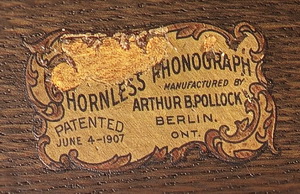
The upper portion of the label on the Waterloo phonograph has been damaged—or possibly deliberately effaced—making it impossible to determine whether it was originally branded "Pollock" or "Schröder." Significantly, the label on an example of this cabinet-style machine, illustrated in the book "Visionary Thinking: The Story of Canada's Electrohome", is similarly effaced.
The soundbox on the Waterloo phonograph is marked: "Phonola Angelus / The Pollock Manufacturing Co. / Berlin, Ontario." Assuming the soundbox is original to the machine, that marking would indicate a date of manufacture no earlier than 1909.
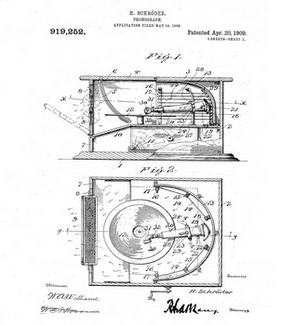
Schröder Patent No. 919,252
|
Detail of sound arm and soundboard
|
|
The Schröder tabletop machine appears to be unique—likely a prototype—which may explain the questionable patent date. Its mechanical arrangement differs markedly from that of the Waterloo phonograph. In the Schröder design, there is no internal horn but rather the soundbox is attached by a short elbow to a flared, bell-shaped sound arm or horn that projects rearward toward a curved soundboard mounted to the sides of the cabinet. By directing the sound waves against this soundboard, the inventor sought to produce a more mellow and resonant tone. This unusual configuration corresponds, in part, to Schröder’s Patent No. 919,252, filed May 14, 1908, and issued April 20, 1909, suggesting a manufacturing date for this machine in late 1908 or early 1909.
Early Pollock phonographs bore notice of the June 4, 1907 Canadian patent originally issued to Schröder. In later years, additional Canadian patents granted to Pollock’s business partner, Alex Welker, appeared on the machines, reflecting the company’s growing technical independence. These included Patent No. 120,099 (August 24, 1909) for improvements in tone arms for talking machines; Patent No. 123,823 (February 15, 1910) for improvements in reproducers; Patent No. 148,695 (June 17, 1913) for an improved motor-winding mechanism; and Patent No. 165,234 (October 5, 1915) for improvements in the construction of talking machines.
In an advertisement published in the Winnipeg Free Press Evening Bulletin on December 22, 1922, The Phonola Co. of Canada Ltd. proclaimed:
Pioneers in the Cabinet Phonograph Industry in Canada.
Exclusive Makers of Phonographs for 17 Years.
The first to build the cabinet design with a concealed horn.
The first to make a motor in Canada.
The first to make a tone-arm in Canada.
The first to make a reproducer or soundbox in Canada.
The PHONOLA is the Outstanding All-Canadian-Made Phonograph
—Designed and built by Canadian experts.
A claim of seventeen years’ experience in 1922 implies that the company’s involvement in phonograph manufacturing began in 1905.
Addendum
As I was completing this article, I made a discovery that introduces additional—and potentially conflicting—evidence regarding the construction of Canada’s first internal-horn phonograph.
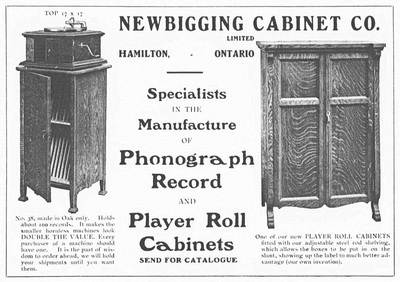
Beginning in mid-1906, advertisements appeared almost daily in The Hamilton Spectator for the Newbigging Cabinet Company, Ltd., located at 164 King Street West in Hamilton, a city forty miles east of Berlin. These early notices promoted show cases, office desks, and store fittings. The firm first drew my attention through a 1912 advertisement in the Canadian Music Trades Journal, in which it described itself as "Specialists in the Manufacture of Phonograph Record and Player Roll Cabinets."
Canadian Music Trades Journal, August 1912, p. 22
|
|
By 1914, Newbigging was producing reinforced cabinets capable of supporting the considerable weight of Edison tabletop disc phonographs. In 1915, the company advertised full-size upright phonograph cabinets for dealers "desirous of changing motors from old-fashioned cases to more up-to-date cabinets." The following year, in 1916, Newbigging introduced its own upright phonograph—the Canadian-made Clarion Musicphone.
In an article published in the Canadian Music Trades Journal in August 1916, R. P. Newbigging reflected on the all-electric Musicphone, the new talking machine manufactured by his company and recently introduced to the market. The journal observed, "The fact that the head of this firm has for long had an intimate knowledge of the talking machine business and has already well-established connections all over the Dominion augurs well for the success of the Clarion Musicphone."
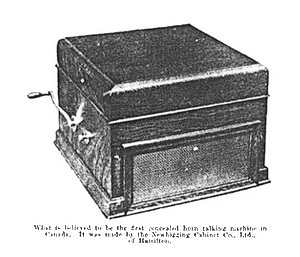
In the same conversation with the Journal, Mr. Newbigging offered a noteworthy claim. While acknowledging he was "open to correction," he stated that he believed the first concealed-horn machine in Canada had been manufactured in his firm's factory. The accompanying photograph, he explained, depicted the cabinet of that machine, produced in 1909 and fitted with a front screen of fine brass wire mesh. "Not only was this cabinet made in our factory," Mr. Newbigging concluded, "but the two-spring motor, tone arm, and sound-box were all made in Hamilton. For the construction of the cabinet we had nothing to go by but a verbal description of the machine. It is a far cry from this first attempt in 1909 to the electrically driven machine we have today. From that day to this we have never stopped thinking talking machines."
Product of the Newbigging Cabinet Company.
Canadian Music Trades Journal,
August 1916, p. 91
|
|
A close examination of the photograph of the Newbigging phonograph reveals a striking similarity to the tabletop Pollock phonograph in the collection of the Waterloo Region Museum. The cabinet is identical in appearance, featuring the same distinctive rectangular wire-mesh screen on the front and the unusually positioned crank hole on the left side. The Waterloo phonograph is also equipped with a two-spring motor, similar to the Newbigging model.
Did the Newbigging Cabinet Company in Hamilton build the first concealed-horn talking machine in Canada in 1909? Several pieces of evidence cast doubt on that claim. The first advertisement for a Pollock concealed-horn phonograph appeared in The Berlin Daily Telegraph in March 1908, offering the instrument for sale at Weaver’s bookstore in Berlin and Waterloo—more than a year before Newbigging’s stated date. Further, in "Visionary Thinking: The Story of Canada’s Electrohome", Raymond Stanton describes the earliest Pollock machine as an upright model resembling the Victor-Victrola VTLA. According to Stanton, the cabinet was manufactured by a local—presumably Berlin—furniture company, rather than by Newbigging.
Curiously, the Newbigging Cabinet Company placed an unusual advertisement in the Berlin News Record on January 2, 1907—repeated on January 3 and 4—reading: "WANTED, Two first-class cabinet makers, only those used to ordered or interior work need apply. Preference to married men. Newbigging Cabinet Company, Ltd., Hamilton." This was the only known instance in which the Hamilton firm advertised in a Berlin newspaper, making the notice particularly noteworthy.
Given the relatively short distance between Berlin and Hamilton, and that Newbigging was already an established cabinet-making firm, it is conceivable that Pollock contracted with the company to construct a tabletop phonograph cabinet. If so, however, the timeline becomes problematic. If the cabinet in question dates to 1909, it could not have been the first concealed-horn machine in Canada. If, on the other hand, it was produced in 1907 or 1908, then it may qualify for this distinction and Newbigging may simply have misremembered the date of what he later described as a momentous achievement.
References
- Bill Pratt, Searching for the Earliest Talking Machine Made in Canada, Antique Phonograph News, Autumn 2023.
- Keith Wright, Phonola and Its Surprisingly-Early Start, Antique Phonograph News, January 2015.
- Raymond Stanton, "Visionary Thinking: The Story of Canada's Electrohome", Canadian Corporate Histories, 1997.
- Ken Seiling Waterloo Region Museum, 10 Huron Road, Kitchener, Ontario, N2P 2R7.
- Trade publications: Canadian Music Trades Journal and Talking Machine World.
- Newspapers.com.
|