|
Edison Gem Presentation
by Domenic DiBernardo
|
|
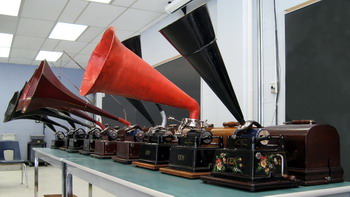
Edison Gem Presentation, March 9th, 2008
Photo courtesy Betty Minaker Pratt
|
|
|
Of all the phonographs offered by
Edison, the Gem was the smallest and
least expensive machine and, unlike
other models, it was housed in an all-metal
case. Introduced in February, 1899, the Gem
was designed to compete with other small
inexpensive phonographs, such as the Columbia
model "Q" which was priced at a very attractive
$5.00. The Gem was the lowest priced machine
manufactured by Edison and sold initially for
$7.50.
Edison had produced a few other models
prior to the Gem phonograph. The first model
marketed was sold as the Class "M", which was
introduced in 1889. Originally sold for business
use, it was modified in 1893 to be sold for
domestic use at a price of $200.00. This model
was later modified and re-named the Triumph
model. The second Edison model (called the
Amet Motor phonograph) was introduced in
1895. It was eventually replaced by the Spring
Motor phonograph, which was introduced in late
1897 or early 1898, at a price of $100.00.
Edison, realizing the need to provide a more
moderately priced machine for domestic use,
next introduced the "Home" model in 1895.
The earliest Home model, known as the Edison
Clockwork Phonograph, was followed quickly in
1896 by the model "A" Home. The model "A"
Home is usually referred to as the "Suitcase"
Home and sold for a more accessible $40.00. In
1898, in a continual effort to compete with lower
priced phonographs on the market, the Edison
Standard Model "S" (which collectors refer to
as the square-top Standard) was introduced at a
price of $20.00.
Many of the Edison phonographs of this
era were sold as package deals, which may
have included accessories along with one or
two dozen cylinders plus a horn. In order to
stimulate demand, both Edison and Columbia
would advertise a new phonograph model for
as long as one or two years prior to its being
available to the public.
|
|
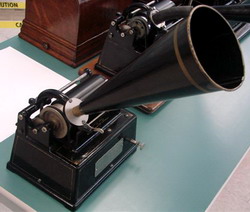
Model "A" Gem
Photo courtesy Arthur E. Zimmerman
|
|
|
With the introduction of the Edison Gem
phonograph in 1899, Edison was able to
compete with the lowest priced models on the
market at the time. In total there were 5 models
of the Gem, from the model "A", (which played
only the two-minute cylinders), to the model "E"
(which played only the four-minute cylinders).
The model "A" Gem sold for approximately two
years before the next model came out. There
were many variants in the Gem line, especially
in the model "A", which endured about 29
minor variations, including type of reproducer,
attachments, decorations, gearing, horns, speed
controls and so on. To keep costs down, none
of the Gem models ever had a spring barrel and
therefore could not be wound while playing.
Some of these Gem machines are very rare and
collectable, not for the phonograph itself, but
because of the attachments and/or decorations.
Later models (which sold for $15.00) were
offered with special finishes, but proved to be
unpopular and thus are sought after for their
scarcity. Buyers of Gems were also offered the
option of upgrading to a mahogany case and
matching painted horn for $19.00. Specially
decorated Gems seemed to be even less popular,
with few buyers paying the additional $4.00
for decorations and fewer still opting for nickel
plating at $15.00 extra. Those who wanted only
the best for their modest little machine had the
option to purchase top-of-the-line gold plating
for an additional $25.00. Being so expensive,
very few were sold with these extras.
#1: Model "A" Gem
The model "A" Gem was introduced in
February, 1899. This Gem, which played the
two-minute cylinders, was offered with a camelhair
brush and an oil can.
The reproducer was fixed onto to the carrier
arm and was held there by two screws. This
apparatus has the weight and stylus of an
automatic reproducer, but it can not be easily
removed. No wooden case was provided with
this model, but other manufacturers began
offering wooden cases for the Gem for $2.50.
With no wooden base on the machine, a metal
drip-pan was fastened to the underside to catch
dripping oil from the various gears. This Gem is
known by collectors as the "Drip Pan" Gem.
The speed control is at the front and is similar
to ones used later by Columbia on their disc
machines. The "A" is wound clockwise and, as
it does not have a spring barrel, it can not be
wound while playing. This machine sold for
$7.50.
#2: Model "A"
|
|
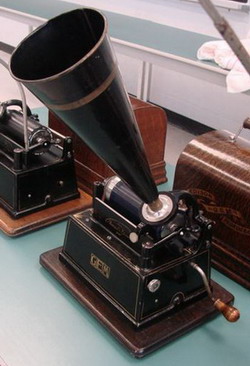
Model "B" Gem
Photo courtesy Arthur E. Zimmerman
|
|
|
The "Branded" case model "A" was introduced
in 1901, had a branded decal on the wooden
lid and a wooden base was also provided. This
model played two-minute cylinders and had a
speed control which had been relocated to the
left side of the machine.
This model was sold with a special light
reproducer and recorder, which was later
replaced by the model "B" reproducer and
recorder, for an additional $3.00. Either a cone
or an all-brass horn was offered. This version
sold for $7.50.
#3: Model "B"
The model "B" was introduced in November,
1905. Similar to the late model "A" with some
variations, the winding key was replaced by a
crank and the motor was moved to the left side
of the machine to allow room for the crank. This
model Gem was wound clockwise and played
2-minute cylinders. A cone horn was included,
until 1907, when an eight-panelled horn was
available and a model "C" reproducer was
provided.
This machine sold for $10.00 with a cone horn
and for $12.00 with the panelled horn.
#4: Model "C"
The model "C" was introduced February, 1908.
This two-minute Gem was similar to the model
"B" but without the swing-arm, which held
the end of the mandrel. This machine sold for
$12.50.
With the arrival of the four-minute wax Amberol cylinders
in 1908, owners of Gems had to wait
until July of 1909 to be able to purchase the
combination attachments required to convert
model "A", "B" and "C" Gems to play the new
cylinders. This four-minute
attachment, with the model "H" reproducer, sold
for $4.15.
In February, 1910, a special model "C"
Gem was advertised with the International
Correspondence School outfit, taking the place
of the Edison Standard phonograph, which
had been used up to this point. The outfit also
included a 10-inch horn, listening tubes, oil can
and 25 conversational records with instruction
papers for four languages, all for a price of
$35.00.
|
|
Model "D" Gem
Photo courtesy Betty Minaker Pratt
|
|
|
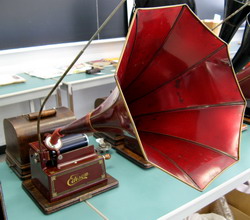
#5: Model "D"
The model "D" was introduced in October,
1909. This is the first Gem model designed to
play both the two- and four-minute cylinders.
Otherwise, the "D" resembled the models "B"
and "C", although the spring was strengthened
to improve performance and duration.
This machine was finished in a maroon colour
with the Edison signature decal replacing the
familiar Gem decal, which had been used on all
previous models.
This Gem also included an eight-panel maroon
horn and a model "K" reproducer. It sold for
$15.00.
#6: Model "E"
In October, 1911, with the sale of the
attachments being slow and most of the Gem
machines still not converted to play 4-minute
cylinders, the Edison company decided to reduce
the cost of all the attachments and reproducers.
In 1912, the model "E" Gem, which played only
the four-minute cylinders, was introduced. Very
similar to the model "D", the machine and the
horn were finished in maroon. Unlike the model
"D" though, the maroon paint was applied over
black paint. The result was that the maroon color
was not the same shade as on the model "D".
|
|
Model "A" Gem with Polyphone attachment
Photo courtesy Betty Minaker Pratt
|
|
|
The carrier arm also had a larger opening for
the reproducer, so it could fit the model "N"
reproducer which used a four-minute stylus.
This version sold for $15.00.
In July 1913, the Gem combination attachment
outfit was introduced, which included ten
special Blue Amberol cylinders, a model "N"
reproducer and special carrier arm, at $4.75.
In October, 1913, it was announced that with the
exception of the school model phonograph, all
outside-horn phonograph production would be
discontinued. Sales figures show that some final
Gems were assembled at the West Orange plant
up to early 1914.
[Domenic’s presentation also included the
following 3 rare Gem machines]
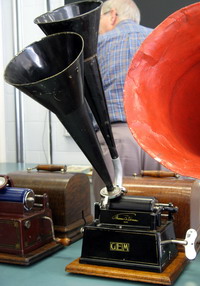
Model "A" Gem with the Polyphone
attachments
This Gem has a Polyphone attachment with two
black funnel horns. The Polyphone attachments
were offered by the Talking Machine Company
of Chicago in late 1898. The contraption has two
reproducers, each with two sapphires that are
about a 1/2 inch apart and that follow each other
in the same groove. This creates an echo effect,
providing a sound similar to a concert hall,
along with increased volume. These attachments
were offered for the Gem (and for most of the
Edison cylinder player models including, the
Standard, Home and Spring Motor) for $15.00
which included two 14" brass horns, or a
concert version which cost $25.00 with two 24”
brass horns.

|
|
Model "A" Gem with Bettini attachment
Photo courtesy Arthur E. Zimmerman
|
|
|
Model "A" Gem with Bettini attachment
This Gem has a Bettini attachment with an
original Bettini papier-maché horn. Bettini was
an Italian engineer who immigrated to New York
City in the 1880s. Bettini, having an interest
in opera and sound recording, thought he
could improve the quality of the recorders and
reproducers in use at the time. After extended
research, he was able to develop a much better
reproducer, which he named "The Bettini Micro
Reproducer". With special Bettini horns and
carrier arms, these attachments were made
for most of the Edison cylinder phonograph
models and for a few Graphophones. He later
moved to Paris, France, where he set up a lab
producing cylinder phonographs and also began
recording his own cylinders. In addition, Bettini
manufactured three models of disc-playing
machines.
|
|
Model "B" decorated Gem
Photo courtesy Arthur E. Zimmerman
|
|
|
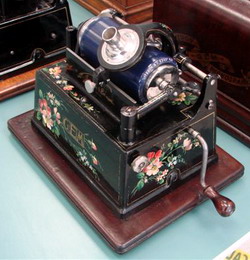
Model "B" decorated Gem
This is a very rare Edison Gem. It is believed
to be the only decorated Gem ever found and
it may be the only one to have survived over
the last one hundred years. It has a mahogany
banner case in addition to having the optional
"flower decorations". This Gem model sold
for $12.00, the optional mahogany case cost an
additional $10.00, while the flower decorations
and gold stripes added a further $8.00 to the
cost. It was very unusual for someone to order
such options on a low priced phonograph.
|