CD
|
|
|
|
Antique
Phonograph
News
Canadian Antique Phonograph Society
|
Mar-Apr 2005
|
|
| Jan-Feb |
Mar-Apr |
May-Jun |
Jul-Aug |
Sep-Oct |
Nov-Dec
|
At The Auction
by Mike Dicecco
As anyone with a computer will tell you, sooner or later us collectors end up on eBay, checking out
the ever-changing parade of items for sale. While my fatherly duties prevent me from going on trips to
any of the Talking Machine shows throughout the USA, I can easily get an idea of what a particular model
is worth (or at least what some fool is willing to pay for it). The variety of unusual phono-related
goods is sometimes staggering.
Lately, I’ve been finding myself on eBay at an almost daily, addicted rate. Perhaps it’s not just the
attraction of finding out that you got a great price at the last CAPS meeting, but maybe, just maybe,
you’ll get a good deal on something that no one else is showing an interest in. Most of us know that
the last 10 seconds of the auction is where all the flurry of activity is, so you might as well wait
until then to enter your bid (and hope your computer doesn’t freeze up on you)!
So here, compiled over the last few weeks, are a few items that I thought you would find of interest -
if not for their monetary value, then for their absurdity. All figures are in Canadian funds.
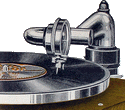
I was all excited when I came across an original Berliner tone arm and reproducer for a Trademark
machine. Mine had reproductions. It even had the rare instruction tag attached. For some unexplained
reason, so many of these machines are missing their factory tone-arms, is there a Tone Arm Heaven
somewhere?. I figured it would sell for a few hundred dollars. Needless to say, the final price of
$1,486 was far more than I was willing to spend (hey, I paid almost that much for the whole machine).
Suddenly, my reproduction tone arm is looking and sounding pretty good!
Recently, I purchased a beautiful Victrola XVII from my friend Brian Livingstone. Its curved hand-carved
cabinet, and gold plating are stunning. Only thing missing was the key. Apparently the XVII’s and XVIII’s
have their own key that was different from all the other models. In addition to being gold plated, it had
a unique shape. Again, eBay to the rescue: here was the missing key, waiting for my bid. I figured $50 or $60
would win it since the normal keys are usually in the $30 range. The final price: $601. For a key! Oh well,
I don’t really have to lock this Victrola anyway ...
Sometimes the absurdity of what people are selling is only outdone by how much it ends up actually getting.
Case in point is an "Electric Victor Victrola". No, it’s not an early electric motor machine;
instead someone ripped the guts out of a Victrola IX, and stuffed a portable record player inside of it
(see photo). It is quite a clever "conversion". The description admitted that it didn’t even work!
Yet still, eight people bid the price up to $51. I can’t figure it out.
While still on the subject of the ridiculous, a seller was attempting to cash in on the publicity surrounding
the recent Michael Jackson trial. Up for consideration was a 1984 Vanity Fair phonograph, with the singer’s
picture and autograph on it. The price? A measly $605,000. Is it no surprise that it didn’t sell?
Being an avid record collector, I was particularly interested in an unusual "Deluxe Special Record"
from 1903. What made it different was that it was 14" in diameter, and spun at 60 RPM. Apparently this
early attempt at a long-playing record was made by Victor for only about a year, and proved to be a commercial
failure (likely due to the sheer bulk). The large diameter also made these records far more likely to be broken
and, as such, few examples have survived. Bidding went up to $316, but the unspecified reserve was not met.
Still, this would have been a great addition to any collection, even if it wouldn’t fit on your turntable.
On the other extreme of the record size spectrum was an early 1890’s five-inch Berliner. This would have
been one of the first flat disk records ever made, and in appearance it resembled the more common seven inch
variety (the lyrics were even included on a label on the reverse). The final selling price reached a staggering
$2,813, with 15 people fighting over it. What song would someone be willing to pay such a high premium for?
"Jack and Jill Went Up the Hill"!
Well, it’s late at night as I type this article; my vision is getting blurry from staring at an almost
endless list of articles for sale. But there’s just one more gramophone I have to check on eBay before I shut
down the computer ...
|
|
"I’d Walk A Million Miles, For One Of your Smiles"
by Charles Marowitz
At the turn of the last century, there was nothing more sacred than Mother. She was the loving, benign,
considerate, wise and protective matrix from which all goodness sprang. Anyone who didn’t love his mother
or leap to her defense when insulted, belittled, or disparaged was more than a cad; he was a monster.
Mom’s most ebullient champion was Al Jolson who, folded on one knee with a catch in his throat and a tear
in his eye, declared that he would "walk a million miles, for one of her smiles" for she was his
irreplaceable 'Mammy'. The song by Joe Young, Sam Lewis and Walter Donaldson became Jolie's unmistakable
crie-de-coeur spawning a veritable army of 'mammy singers'. The paeans of praise to Mom's iconic stature
in the family circle could be found on records and cylinders throughout the land. "Cross My Heart Mother,
I Love You" was the title of one musical vow, "I'd love To Fall Asleep And Wake Up In My Mammy's
Arms" was another. Mother was grateful for such sentiments as could be divined from Ketheley & Thompson's
"May God And His Angels Guard You, That Is Your Mother's Prayer". Trace & Pinkhard expressing their
maternal fervor, wailed "Mammy O'Mine" while Eddie Cantor via Morse and Johnson pleaded "I Want
My Mammy" and soldiers departing for the trenches choked back tears as they sobbed: "So Long, Mother".
"Was There Ever A Pal Like You," Irving Berlin asked weepily and, of course, there wasn't. And, Joe
Goodwin and Gus Edwards agreed, there was no coupling quite as reverent as "Your Mother and Mine".
Should mother's offsprings foolishly attempt to substitute alternative guardian-angels, Byron and Goetz reminded
us on her behalf, she's "The Only Mother That You Ever Knew". And, while comparisons were being made,
Hager and Goodwin drew our attention to "That Wonderful Mother of Mine" as "Pal Of My Cradle
Days" asserted the memory of Mom as our earliest, fondest and most reliable friend.
Occasionally Father got a look-in with songs like "Daddy, You've Been A Mother To Me" and sentiments
such as "I Want a Girl, Just Like the Girl, That Married Dear Old Dad" – but clearly, Daddy was an
also-ran compared to Super-Mom. The finest compliment any man could bestow on their beloved was expressed in
Irving Berlin's "You've Got Your Mother's Big Blue Eyes" or George M. Cohan's plaintive, "You
Remind Me Of My Mother". It wasn't until the 40s that Mary Martin could openly confess "My Heart
Belongs to Daddy", but of course, a 'sugar-daddy' was not in the same category as a natural progenitor.
Finally, in an anthem written in 1915 by Theodore Morse with words by Howard Johnson (who was not related to
multi-flavoured ice-cream magnate but might as well have been), the maudlin reached epochal proportions in
"M-O-T-H-E-R".
M, is for the million things she gave me
O, means only that she's growing old
T, is for the tears were shed to save me.
H, is for her heart of purest gold.
E, is for her eyes with love-light shining
R, means right as right she will always be,
Put them all together they spell MOTHER,
A word that means the world to me.
As the century slithered into the twenties, Mother emerged as a gray-haired old lady who had been underappreciated,
neglected or abandoned – and only when she was gone did children painfully realize the enormity of their loss.
And because they did, singers like Vaughn De Leath in 1927 could counsel others to "Baby Your Mother As
She Babied You, Back In Your Baby Days"; a touching ballad with disturbing Alzheimer undertones.
By the time the hard-bitten thirties arrived, Mother-Worship had more or less been put on the shelf and songs like
"M-O-T-H-E-R" were wickedly parodied by the cynical members of the smart set. Sophie Tucker and Dolly Kay
were singing about 'red-hot mommas', predatory older women who ate up and spat out helpless male victims.
When the forties rolled in, social critics such as Philip Wylie, the great antagonist of Momism, was able to write;
"…megaloid mom-worship has got completely out of hand. ....Mom is everywhere and everything and damned near
everybody, and from her depends all of the rest of the U.S. Disguised as a good old mom, dear old mom, sweet old
mom, your loving mom, and so on, she is the bride at every funeral and the corpse at every wedding. Men live for
her and die for her, dote upon her and whisper her name as they pass away, and I believe she has now achieved,
in the hierarchy of miscellaneous articles, a spot next to the Bible and the Flag, being reckoned as part of
both in a way." Then in a great thunderous finale to his diatribe, Wylie proclaimed: "I give you mom.
The destroying mother. I give you her justice – from which we have never removed the eye bandage. I give you the
angel – and point to the sword in her hand....... I give you the woman in pants, and the new religion: she-popery.
I give you Pandora. I give you Prosperine, the Queen of Hell. The five-and ten cent store Lilith, the mother of
Cain, the black widow who is poisonous and eats her mate.... Our society is too much an institution built to appease
the rapacity of loving mothers." It's enough to make Betty Friedan hemorrhage and Gloria Steinem reach for her
uzi.
In today's popular music, one is more likely to encounter 'Mother' with a six letter extension added, an
inescapable expletive in rap music. In the minds of most kids between 13 and 21 'mother' is simply an abbreviation
for that 12-letter obscenity. Mothers, per se, are the scourge of unruly and rebellious children and often the
jettisoned cargo of deadbeat fathers who try to evade alimony-payments and, disdaining broken homes and family
values, dump Mom in their quest for younger, trophy-wives. The angelic, Madonna-like mother that was celebrated in
the songs of the past has been replaced by a botox'd wax-figure who shops and gossips, pampering herself endlessly
as she presides over domestic carnage and, regularly outliving 'Daddy', luxuriates on his inherited wealth.
Or are we simply saying that the Age Of Innocence has been replaced by the Age of Egocentricity and the nostalgia
we may still summon up from the early 20th century shellacs, belong to a vanished era? It may well be, but so long
as turntables revolve on gramophones piping out the music of 78 rpms through ancient horns, no flood of CDs, DVDs,
Videos or i-Pods will ever destroy the preserved culture of that sweeter epoch.
Charles Marowitz is a professional writer, stagedirector and amateur musicologist who obsessively collects 78 rpm
records.
|
|
Wright's Stuff or This Page Intentionally Blank:
Practicing Phonograph History
(with apologies to the late Barbara W. Tuchman)
by Keith Wright
When this newsletter arrives it will be approximately eighteen months since Lloyd Swakhammer, then Past
President of the London Radio Club, conspired with me to challenge CAPS to do something about preserving
the history of Canadian phonographs. So far we don't seem to have much to show for it and as time goes by
more and more is lost. I realize it won't be easy. What follows is a description of when I attempted to
practice some Real History a few years back. First I'll describe why it even happened.
When I began inquiring about a certain machine built in the province of Quebec I was essentially greeted with,
"Yes, we see them in the flea markets from time-to-time. So what?" But my background already had me
'sensitized' to them. My grandfather was a church organist in Liverpool, England; my parents sang with church
choirs all their lives; and I was invited by the choirmaster to sing with the adult choir at age 9 or 10 -
probably at least in part to remove barriers to my mother's attendance at practice. Instead of going to rock
concerts, I went to recitals by the likes of E. Power Biggs, Gillian Weir and Virgil Fox (purists are allowed
to shudder). I also have some actual organ pipes kicking around the house from when an organist conducted a
midnight pipe-ectomy for souvenirs after the pipe organ was sold (to be replaced by an electric thing). So
when an acquaintance (who studied with a master cabinet maker and could return kindling to drop-dead
factory-fresh machines) mentioned he had a "Casavantee" [sic] for me, my radar went off. "Where
does it say it was made?" "Saint Hyacinthe." I needed to see it. Then I needed to have it. Then
I needed to know more about it.
The machine that now graces our upper landing looks very much like a Victor Victrola VV-IX in oak. They have
similar dimensions, same basic styling and essentially the same technology including a manually set automatic
stop. The tone arm and reproducer are branded 'Superior Universal Reproducer', which is one of the 'clone' firms
operating in Chicago after the major Victor/Columbia patents expired. It is of the type that you can flip to play
either lateral or hill-and-dale cut records. I imagine this was a selling feature in Quebec to degroove those
French language Pathé records. (I have noticed that the machine has sounded its happiest playing a
Phonola hill-and-dale record.) The motor is a surprisingly light weight double-spring model helpfully stamped
with 'The Motor'. But it is the woodwork on the Casavant's internal horn that says 'organ maker' to me. Pipe
organs need to be encased in wonderful carpentry to lift the spirit visually as well as sonically. I like
taking off the chintzy front grill and looking at the internal horn. The 'volume control' also makes me think
of an organ stop. Enough about the machine, what about the history?
As we know, when internal-horn disc machines went into their 'clone phase' (much like PCs some years back)
they were routinely cobbled together by firms in other lines of business: aircraft manufacturers, piano makers,
furniture makers and organ builders. In order: Curtiss; Heintzman and Brantola; McLagan and Pollack/Phonola/Electrohome;
and Casavant. Casavant Frères opened in 1879 at Sainte Hyacinthe, Quebec. The brothers were following in the
footsteps of their father, who had been making pipe organs since 1840, including the largest one then in North America for
the cathedral in Bytown (now Ottawa). "By 1996 the firm had delivered more than 3,750 instruments and continued to
dominate the North American market, without neglecting its exports throughout the world." (From The Canadian Encyclopedia.
There is also an award-winning one-minute history seen as a commercial on TV. Casavant's web site currently lists 'Opus 3765'.)
I adopted a 'direct approach' and sent an un-guided missive into Casavant Frères, Ste. Hyacinthe, PQ. A reply eventually
came from 'The Assistant To The Tonal Director':
Thank you for your message and information.
Casavant Frères built phonographs between 1919 and 1926 using RCA turning table.
Thank you for your interest.
RCA turning table? I don't think I need to get into the details as to why this reply had serious credibility gaps for me.
Later I was told that everything had been sent to the 'museum of civilization' so, following this clue, I tried the Canadian
Museum of Civilization in Hull, Quebec (anyone spot my mistake?). When the museum searched their on-line catalogue they told
me "no phonographs here" and steered me to the Canada Science and Technology Museum (NSTMC). That's how I met Bryan
Dewalt. I thought I was getting somewhere since there is a picture of an upright Casavant on that museum's website. Bryan
kindly copied some Casavant catalogue pages for me and told me about a book on the firm that very briefly (don't blink) mentions
phonograph production. He also sent: "Casavant Frères established La Compagnie de Phonographes in St-Hyacinthe, Que
in 1919. Not known if they built them before but from 1911 to 1918 Casavant built cabinets for Victor Talking Machine at its plant
in South Haven, Michigan. The St-Hyacinthe subsidiary was dissolved in 1927 - don't know if all phonograph production was ceased.
No production figures."
The museum's machine is believed to be a No. 125 but the grill is different. I have a similar problem in that my tabletop looks
like a No. 50 but the grill matches the No. 100 upright and the plate inside says 270 (Model#? Serial#?). Bryan also said that
there was a wealth of material in Casavant's extensive archives! But Casavant said they'd sent everything to ... round and round
we go.
Armed with this information, I contacted Robert Baumbach about Casavant's making Victor cabinets out of the Michigan plant. Bob
stopped looking for the dog long enough to shoot that down instantly with: "Victor always built their cabinets themselves.
They never used a third party."
I did painstakingly go through the (French language) pages in Casavant Frères, 1879-1979 by Laurent Lapointe and put
together a rather interesting story:
[Because] of their competence "in the questions of sonority and the laws of acoustics", and experiments in [cabinetry],
[Casavant] undertook the manufacture of phonographs. To this end, in 1919, they incorporated another company with limited
responsibility [called] La Compagnie de Phonographes Casavant Limitee. This enterprise was really born in the factory since the
first machines were initially made by some employees eager to get a gramophone [cheaply](!). This practice authorized by the
owners was transformed soon into [a] serious project and, after a few months of studies and experiments on various apparatuses,
[they began] the manufacture of an instrument that gave satisfaction to the Casavant brothers. At the beginning [they] did not
seek to produce [machines] in great quantity, but the reputation of the Casavant phonograph was propagated rather quickly from
Saint-Hyacinthe and those which visited the organ factory did not fail to underline [the] quality of it. These first successes
[led] the Casavant brothers to consider the prospects [for going into this business] and the decision was made to [increase]
their production and to incorporate the company in 1919. A building was bought and [they] installed the necessary production
equipment. After one year, 20 employees under the direction of Joseph Touchette, the former harmonist as a chief of the branch
of South Haven, produced 13 different models for which the demand became so strong that it surpassed production capacity (!).
Successes of this company were short and "the acquisition of [the remaining] woodworking machines and the motors of La
Compagnie de Phonographes Casavant" by the organ enterprise put the end definitively of the manufacture of phonographs in 1927.
By the way, the catalog pages from NSTMC show only 9 machines, not 13. I have seen two other examples of my machine in the 'antique
corridor' between Montreal and Quebec City bearing slightly different models of the 'Superior' tone arm. Also, there was one sad
lidless Casavant tabletop relic labeled 'Phonographe de La Patrie' (Gramophone of the Fatherland) I discovered in Ontario.
So, now I'm stuck. I finally figured out (with something Jean Paul Agnard wrote in passing) that the museum that Casavant likely
graced with their documents is the Musée de la civilization in Quebec City! Duh! Given the geographic distance and my
grade 11 French I now leave it to others to expand on this story with a full catalog of models and production figures - and
find out if Casavant really did build anything for Victor. However, I submit this material (along with more pictures) to a future
CAPS Canadian Phonograph Encyclopedia.
And I still had a good time telling my father on the phone, "I have a Casavant in the house." I wish I could have seen
his face.
For further reference:
www.casavant.ca
www.sciencetech.technomuses.ca (search for phonograph)
Casavant Frères, 1879-1979, Laurent Lapointe (Société d'histoire régionale de Saint-Hyacinthe, 1979)
Got any information on Brantolas from the Brantford piano maker? Got an idea for a 'blank page'? Contact Keith at info@CAPSnews.org
|
Casavant Organ, "Opus 1409", Holy Rosary Cathedral Regina, Saskatchewan, Canada. Visually and sonically soaring. (Casavant Frères)
One of the old buildings still standing at the working factory.(Keith Wright)
Casavant model 270 (?) is similar to a VV-IX. (Keith Wright)
Casavant offered competitive options. (Keith Wright)
Models used hardware from a third party in Chicago. (Keith Wright)
Model 270? Serial number 270? (Keith Wright)
Lidless tabletop ghost from an Ottawa area dealer. Labeled 'Phonographes de La Patrie'.
Reminiscent of other makes. (Keith Wright)
Different grill from my 'model 270' available in oak or mahogany. (Catalog courtesy NSTMC)
Fancy mahogany model. (Catalog courtesy NSTMC)
The Casavant gramophone at the National Museum of Science and Technology. (Courtesy NSTMC)
|
|
|
|