CD
|
|
|
|
Antique
Phonograph
News
Canadian Antique Phonograph Society
|
Jan-Feb 2005
|
|
| Jan-Feb |
Mar-Apr |
May-Jun |
Jul-Aug |
Sep-Oct |
Nov-Dec |
CAPS Lifetime Member Passes Away
by Doug Platt
About 50 years ago I needed some two-minute cylinders for my key-wound Edison Gem. I answered an ad in
the Toronto Star from a man who claimed to have some. I drove to his home in Scarborough and was
escorted down his cellar steps into a veritable "fairy land". Horns of every shape size
and colour hung in profusion from the rafters. Machines of every make and size filled most of the
basement and what was left contained thousands of parts. That trip netted me five 2-minute cylinders,
an Edison Amberola 75 plus the pleasure of making a true, and as it turned out, lifetime friend. His
main passions were his family, the RCAF, friends and the promotion of CAPS, an organization that honored
him with a rare lifetime membership. I am sure that most of you members have already identified the
gentleman described above as the irreplaceable, and deeply missed William (Bill) Tarling, who passed
away at Scarborough Grace Hospital on November 23, 2004 in his 91st year.
|
Bill Tarling
|
|
The Telegraphon: A Recent Find
by Jean-Paul Agnard
I recently purchased on Ebay a unique machine that is a completely unknown application of wax
cylinder recordings (the machine is as big as a Triumph). It is in fact a vocal box used in Germany
in the 20’s (and possibly in some American towns). About 2 years ago I bought from the US on eBay
one of these crazy size cylinders for this machine which is as long like a Celeste cylinder
and as wide as an Inter Pathe cylinder with a label in English.
I have owned such a cylinder during 30 years, since Bill Endlein gave one to me; and during all
these years, I was wondering what kind of machine could use them (see my paper in the Jan.-Feb.
2003 issue). By my contacts with German collectors, through the Internet and eBay, I received a
copy of a patent from 1921 in France by the German Telegraphon Company of Berlin, for a machine
with 2 of these huge cylinders, mounted one after the other. The patent showed how when used the
recording was to be able to pass from the first cylinder to the second one without any interruption,
as if only one cylinder, twice as long, were used. The French name used for this kind of machine
was a revelation: telephonographe: a phonograph used in connection with a telephone. In fact, when
you wanted to send a voice message to a relative without a telephone (or one to yourself), you just
had to find a phone, dial the number of the Telegraphon Company and ask for a cylinder to be placed
in one of their machines. You may have, then, 5 or 10 minutes to say to your correspondent what you
had to say. The company, then, gave you a reference number for your recording and you just had to
send a telegram (i.e. Telegraphon Company) and ask your friend to phone to the company and give the
reference number for the recording.
This is why after 30 years of fruitless researches, I could not find any advertising in old catalogs,
as these machines were not ever sold to the public. This was an apparatus used only by the company which
certainly destroyed nearly all of them when they became obsolete.
My German correspondent told me that a few days after I purchased the machine that he received a
German Talking Machine newsletter (similar to the APN) and as unbelievable as it seems inside there
was an article about... the Telegraphon Company. He is presently translating it for me. What puzzled
me is that he said that there were no pictures accompanying the article. Strange that they could not
find one to illustrate their article. Is it possible that mine is the last one of an extinguished line
of cylinder machines?
As for the price, I was very surprised at the deal I got because during the 10 days of the sale I could
see that a few telephone museums were among the bidders. My maximum bid was 1678.90 Euros (if I remember
correctly) but when the auction ended I managed to win the item for 301 Euros, a ridiculous price, as it
is not even the price of the 2 cylinders included. Maybe the European summer holidays (when everybody is
gone for one month) kept other European collectors from bidding and this is what saved me so much money.
For me this is not like any other cylinder machine, or any cylinder doll or any "Dictaphone",
but a new, unknown among collectors, application of wax cylinders unknown among collectors.
|
|
|
The Better Land
by Arthur Zimmerman
Amphion (UK) has issued a collection of four CDs, "The Better Land", an anthology of
the "great boy sopranos", recorded between 1913 and 1969 (PHI CD 158, 159, 167 and 168),
plus "The Glory of the Temple Church Choir", 1922- 35, directed by George Thalben-Ball
(PHI CD 172). Quite a few of these recordings derive from rare test pressings and unique soft-cut
discs preserved by the boys’ friends and families, and are issued here for the first time. Amphion’s
sound quality, using the CEDAR Process, is quite acceptable. The repertoire is, of course, English
church music, hymns, oratorio arias, simple lieder, old folk songs and charming salon songs of the
nineteenth century.
These recordings derive from the end of a golden age of this sort of voice production, achieved
through superior training methods. The notes refer to the ancient traditions of boy choristers and
soloists, with Italian roots perhaps related to the art of the castrati, and assert that the quality
of boy sopranos has declined seriously since the Second War. The writer tackles the old controversy
of whether these boys sing in falsetto or with true head tones, some boys continuing to sing this way
well into their late teens. He also argues that it is easier to train a boy to sing high notes than
to teach a woman, but does not go on to say that it is far pleasanter to listen to a competently trained
female soprano hit, sustain and colour a high note than to listen to the feeble pipings of the best boy
soprano. The boy soprano genre must be an acquired taste. The sweet fluting of these little chaps has
little tonal interest or colour, not enough bellows power to sustain high notes and unreliable general
note security at the most critical times. Although this is a collection of the very best of the English
boy sopranos, the listener is not spared out-of-tune singing, stabbing at high notes and unevenness and
wobbling on sustained notes.
It has always been a mystery to me why half-baked child singers are put forward and approved of in sacred
services and during religious festivals. The sound is not pleasant and the music usually lacks understanding
and feeling. And always, in the back of my mind and in the pit of my stomach, are recollections of the
horrors that boy choristers, especially, have traditionally been given up to at the hands of pedophilic
choirmasters. An aged friend, a former English choir boy, laughingly told me that the big boys in the
choirs would warn but not protect the little ones. If you like the sound of the boy soprano, backed by
orchestra, organ, piano or chorus, then you may like these recordings. I would not give them a second hearing.
|
|
Wright’s Stuff or This Page Intentionally Blank: The
Perfect Portable Gramophone
by Keith Wright
Ever drag an upright gramophone up a flight of stairs? How about a very long turn-of-the-century
institutional flight? Did you do it for 'fun' and drag it back down a couple of hours later? I did
it once for my very first school demonstration where I lugged my 'The Duke' model Phonola up to the
back of the second floor library where they had a perfect space for me. Right then and there I decided
I wouldn’t do that again and made sure every subsequent piece of hardware representing the decades of
recorded sound would be more portable. (At the moment I keep mentally wrestling with why I’m literally
wrestling with a VV-IX. The second floor has turned into the rule and not the exception. Ever go up a
couple of flights with one of those?)
That’s how I became a little more in tune with portables. (Ok, my first was many years earlier but I
got it because of the novelty that it was made by the manufacturer of my 'serious' turntable.) Then
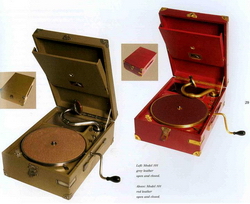
I saw my first HMV portable. The long, thin shiny tone arm and the dimensions of the black case struck
me as more elegant than any other I’d encountered. When I eventually learned the trick about taking
off the platter I discovered it was a model 101. Ever hear an HMV 102? It is the product of 'orthophonic'
technology and is absolutely astounding for its size. I was hooked…again.
As I continued to learn, it struck me that the portable was one thing that HMV did better than it’s
separated-by-surgery Siamese twin, Victor. The Victor Victrola 35 was the archetype for most subsequent
HMV portables but except for the obvious example of the VV-50 and the VV-35 look-alike, VV 1-5, Victor
in my eyes churned out a lot of ugly metal portables. But where do you go to learn more about HMV?
Sure, Mr. Baumbach put out a great field guide for Victor, but you’re not going to find anything about
your HMV 102 in there.
Question: The HMV 101 was made from 1925 to 1931, when it was replaced by the HMV 102. What was the
last year the HMV 102 was officially available? The answer is at the end.
In 1999 Barry A. Williamson compiled and introduced the book, H.M.V. Gramophones 1921 to 1936. This
slim volume was aimed, "to provide sufficient details, for most owners to determine the model number
and dates when their H.M.V. gramophone was extant." It was essentially a compilation of illustrations
from catalogues. I certainly found it useful after I’d ordered it through Phonoservice in Liverpool, England.
However, because of its nature and origins, the small 158 page, black and white volume did not supply
everything I wanted about my portables. To be fair, though, its mandate is ALL machines between the dates
in question.
You have to admit that the entire universe of knowledge regarding portable wind-up gramophones made by
HMV seems a little light to produce a coffee table book such as those we get from Messer’s Fabrizio and
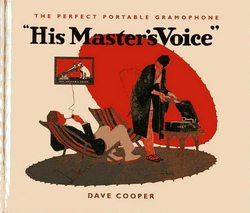
Paul. However, in 2003 I picked up The Perfect Portable Gramophone, by Dave Cooper and was surprised at
how close it got. This 124 page volume, chock full of 290 colour illustrations is a worthy companion to
the Williamson volume in that Cooper weaves a story between the copious pictures of machines, period
advertising and other materials while concentrating on portables. Okay, it was more an end-table book.
In it, there is a chapter on the 'Beginnings of a New Industry', chapters devoted to each of the major
machines, a short chapter on 'The Merger of Two Giants' (Columbia and His Master’s Voice to form EMI)
plus some collector’s tips including cleaning and repairs. It is an attractive volume and it was certainly
a steal when I bought it online.
As an added bonus the book includes a CD of 'typical' music from the era. The transfers may not be able
to compete with others and I have read some criticism of the choice of tracks which include: Armstrong
with his Hot Five and Duke Ellington with his Cotton Club Orchestra; Noel Coward; Ray Noble; and Ambrose
and his Orchestra. It is a slice of 1929 to 1940 with most tracks dating from 1929 to 1932. Negatives aside,
between the sound of the CD and the sides it includes, I felt like I was writing this while listening
through my father’s ears 60 years ago. There is a uniform 'elegance' to whole thing. The CD 'changed the
wallpaper' if you know what I mean.
I think I scored a real bargain.
Oh, and the last year the HMV 102 was available? It was 1960! A forty-year run! Just imagine that
happening today. It makes sense, because electricity didn’t make it everywhere — and someone had to be
buying machines to play those Beatles 78s. Unfortunately, some of the motors from those machines now
end up in the ubiquitous outside-horn knock-offs (okay, I didn’t want to type 'crapophone' again). They
are conspicuous by the angle at which the handle sticks out. Come to think of it, they’re easy to lug up
the stairs—but they won’t sound like a 102.
|
|
|
At The Auction
by Mark Caruana
Recently there has been some debate about phonograph prices on Ebay and whether they are low or stable. It seems to me
that over the last while prices have been a little soft but the good stuff seems to still capture the interest of the
bigger spenders. Unfortunately for me the few items I have parted with lately have gone for less than I feel they
should have. Mind you some of my woes are the result of the high Canadian dollar, which used to provide a windfall
when marketing to the US. But as far as buying goes it’s a great time to pick up a few bargains and as you will read
later in this article, there are some deals that we should all be kicking ourselves for passing up on.
In October, one of the most coveted Edison phonographs made its way onto Ebay and if you were willing to cough up
$15,000 (all prices in $US) you could belong to the select group of collectors who could boast that you own an Edison
Idealia. This rare machine was Edison’s top of the line cylinder machine from 1907 to 1911 housed in a mahogany cabinet
with oxidized bronze metal parts. For those whose interests are more for the Columbia style of machine there was a
Columbia Home Grand Graphophone AD machine which is one of the rarest Columbias you could hope to find. This machine
came fitted with both a fixed 2-inch mandrel and a slip-on 5-inch mandrel. This robust machine was advertised as being
able to play nine cylinders on one winding and after 16 bids this gem sold for a handsome $10,975 which included 75,
2-inch cylinders and 8, 5-inch cylinders.
I was very interested myself, in the Edison Kinetoscope/Phonograph poster, which looked to be in mint condition. This
went for a very reasonable $225. Another Edison advertising item, which caught my attention, was a superb clock, which
advertised Edison’s Gold Moulded Records on its face. Even at the final price of $2,275 the buyer made a wise investment
in what is surly a rare item of wide interest (I base this on the fact that I have not noticed this item in one of Tim
and George’s books).
Now we move onto the portion of the article where we all gasp at what we missed. I will dwell on only two of several I
came across. The first is the European Concert Phonograph, which sold for $601. A pittance for this combination 2-inch
5-inch mandrel machine. I could understand if it was from a European seller but this item was located in the US so
shipping for most bidders was not a problem.
Take heed, this final item is bound to cause the most chest grabbing. A European tinfoil phonograph dating from about
1880 sold for a staggeringly low $3,570! Where was everybody? How could so many people pass up a machine worth roughly
$14,000? It probably didn’t help that the title on the item was "643: Zinnfolien-Phonograph, um 1880 – Tinfoil".
That’s your excuse, but I followed the thing right to the bitter end.
|
|
|
|
|