|
STANDFIELD MACPHERSON COMPANY, PHONOGRAPHS
What’s in a Picture - Applied Forensics
by Arthur E. Zimmerman and Betty Minaker Pratt
|
|
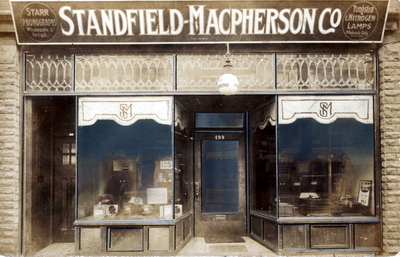
This unlabelled "mint" postcard of a phonograph store in Toronto led the authors Arthur
Zimmerman and Betty Pratt on a remarkable research quest to find out everything that could
be discovered about the store, the proprietors, the merchandise they sold and the fate of the
business and of its owners. They even managed to date the photograph to within one week! |
|
|
This story is about the fun that we had in
asking and in trying to answer questions
about a photograph of an unidentified
phonograph / gramophone wholesale and retail
store, and about the information about the
industry and the people in and around it that can
fall out of such a study. We are still amazed by
what this photograph has told us.
Betty and Bill Pratt are always on the lookout
for pictures, handbills and documents of
Canadian piano and phonograph / gramophone
factories and stores. Betty found
our cover photograph at a card
show a few years ago. There
was nothing useful printed or
written on the back of this Real
Photo postcard, the only clue
to location being street number
499 on the front door. No street,
no city and no date. One day,
walking along Bloor Street just
west of Brunswick, Toronto,
Betty recognized the facade from
the bevelled glasswork frieze
pattern above the storefront and
the street number matched. Upon
comparison with the postcard,
499 Bloor Street West was the
store in the photograph! This
store at the western end of the
8-section Gallanough Block was
where Standfield-Macpherson
Company (S-M), the Starr
Phonograph and bulb dealer, had
been. The Pratts then went to
Might’s Toronto City Directory
and found that the Standfield-
Macpherson store was there
around 1920.
|
|
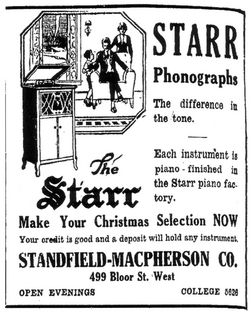
Starr advertisement for S-M at 499 Bloor Street West (TDS Nov. 22, 1919, p. 14).
Note the telephone number, College 5626, which the business retained
throughout its existence.
|
|
|
Who were Standfield and
Macpherson, how did they
come to be Starr dealers and
what became of the business? Once we began
the search, answers tumbled out very quickly.
We went back to Might’s Directory and to the
City of Toronto Assessment Rolls (CTAR) to
check out the time-line and management, to the
Canadian Music Trades Journal (CMTJ) and to
The Toronto Daily Star (TDS) and Globe (G)
databases for backgrounding, advertisements
and personal data.
DATING THE PHOTOGRAPH
|
|
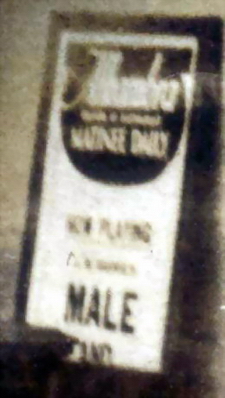
Detail of Alhambra Theatre
advertisement in the store
window, right side
|
|
|
There is a small sign
at the far right in the
right-hand window,
at a bad angle against
the outside wall. We
struggled with the
parallax problem
and, after much
effort understood that
the film "Male and
Female" was playing
at the Alhambra
Theatre, Bloor and
Bathurst Streets. That
was a Cecil B. de
Mille film, released
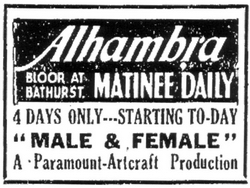
in late 1919. It played
at the Alhambra on
March 1-4, 1920
(TDS Feb. 28, 1920,
p. 7), though it may have returned later, so the
photo could have been taken in that first week
of March, 1920.
The store sign was made by The Macey Sign
Company, which still exists as Macey Neon, a
trade name of Sicon Sign (652013 BC Ltd.) of
Vancouver. The original contract is lost.
|
|
Alhambra Theatre advertisement for de Mille’s "Male and
Female" (TDS March 3, 1920, p. 27)
|
|
|
THE OWNERS
The owners of the business were Melville Edgar
Standfield and Archibald Harold Macpherson.
We derived a great deal of personal information
about them, their work and family histories from
Might’s Directories, CTAR and the newspaper
databases.
In the current telephone book, we found and
called the only Standfield in Toronto. With
their kind assistance, we have now talked
and corresponded with three members of the
Standfield family, in Lachine and in Vancouver.
Finding Macpherson’s descendants was far
more difficult. We followed several leads,
contacted Clan Macpherson, and finally paid for
a severely edited copy of the death certificate
through FIPPO, from which we found the
obituary notice (ET April 5, 1961, p. 40), the
will (AO RG 22-356, #1431 Grey Co., Grant
#149, May 31, 1961) and the name of his
nephew, Stuart Crawford Williams. We then
visited the family plot in the cemetery, got the
nephew’s vital dates, and it was his obituary
(KWS April 16, 2004, p. 33) that led us to
the surviving branch of the family. There is a
family memory of Macpherson’s being in the
phonograph business, but no memory of the
Standfield partnership.
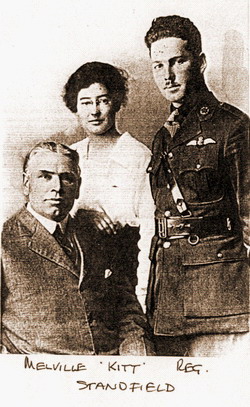
|
|
The Standfield family of apartment #5, 310 Brunswick Avenue:
from left Melville, Mary Kathleen "Kitt" and Reginald, circa
1919 - 20 (courtesy of Gary Standfield)
|
|
|
Melville Edgar Standfield
Company president Melville Edgar Standfield
(London, Ont., Sept. 1, 1870 – Toronto,
March 12, 1922) was descended from Thomas
Standfield, one of the Tolpuddle Martyrs of
Dorset, England (DT July 2, 1997) who
settled in London, Ontario, in 1844. Melville
came to Toronto in 1906, worked as an
accountant and traveller for some office
supply companies (Copeland-Chatterson
Co. Ltd. in 1907-08, and Canada Stationary
Co. in 1909), then as Standfield & Hudson
"systems experts" in 1910. After the death of
his wife, Amy Holmes
(1868-1910), Melville
went out on his own as a
business expert. In 1915,
he was listed in Might’s as
secretary of Commercial
Account Registers, Ltd.,
office supplies, and also
as M.E. Standfield & Co.
He had two children, Mary
Kathleen "Kitt" (married
Hugh Miller; TDS Aug. 29,
1921, p. 10) and Reginald
Edward Holmes (who
married Hugh Miller’s
sister; see below).
Melville turned up as a
very successful travelling
wholesaler for the
Canadian Phonograph
Supply Co., London, in
the last months of 1917 (CMTJ Dec. 1917, p.
63; TMW Jan. 15, 1918, p. 41). This company,
begun in April 1917 by John A. Croden and
W.D. Stevenson of London, was the exclusive
Canadian distributor for Starr phonographs
and records of Richmond, Indiana (CMTJ
April 1917, p. 59). Perhaps Melville’s family
connection with London had something to do
with his association with the company, but
we cannot yet prove it. A few months later
Melville was put in charge of the Toronto
branch stocking samples, possibly a wholesale
showroom, in addition to his Ontario territories
(CMTJ Feb. 1918, p. 73). By the end of the
year, he was out west for the company (CMTJ
Nov. 1918, p. 71), now the Starr Company of
Canada (CMTJ April 1918, p. 81). Perhaps
Standfield-Macpherson Company was a product
of Starr’s aggressive campaign in 1919 to
recruit new dealers and to promote its new
lateral-cut Gennett records.
At the time of his premature death from
heart disease on March 12, 1922 (ET Mar.
13, 1922, p. 19; TDS Mar. 13, 1922, p. 12;
G Mar. 13, 1922, pp. 1 & 11), as well as
president of Standfield-Macpherson (S-M),
Melville was president of the Phonograph
Dealers Association, Honorary President of the
Bloor-Bathurst Business Men’s Association
(he was known as the Mayor of Bloor Street),
President of the Federation of Business Men’s
Associations, a member of the Town Planning
Commission and a member of the Board of
Control subcommittee to investigate Toronto’s
street lighting system. He was remembered as
"a man of forceful personality and a natural
leader of men" (G ibid.).
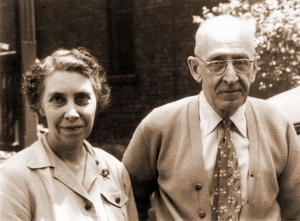
|
|
Archibald Harold and Oreta G. (Call) Macpherson, probably early 1950s
(courtesy of Grace Williams and Kathryn Spencer-Lee)
|
|
|
Archibald Harold Macpherson
Melville’s business partner and vice-president /
secretary-treasurer, Archibald Harold
Macpherson, was born to wholesale fruit
dealer Alexander Crawford (c. 1857-1917)
and Phoebe Ann Macpherson of Winnipeg,
February 14, 1892, and from around 1906
lived mostly at 182 Jameson Avenue in the
Parkdale district of Toronto. He went to Queen
Victoria Public School, at King and Close, and
attended Jameson Avenue Collegiate (called
Parkdale Collegiate after 1910) in 1907-08.
Then he worked as a clerk for Canadian Cereal
& Milling (1911), Bell Telephone (1912),
Macpherson Realty Company (1913), Toronto
Hydro (1915) and for the C.N.R. in 1919
before he joined S-M. He married Oreta "Reta"
Gertrude Call (1892-1957) of Indiana, but they
had no children.
We found Grace Williams, the widow of his
sister Gladys’s son Stuart Crawford Williams, in
Eastern Ontario. She knew him as Harold and
described him as very quiet and kind, but a man
who didn’t talk much and kept to himself a lot.
The family believes that Harold invested his
inheritance in Standfield-Macpherson.
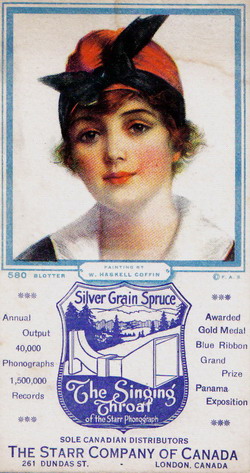
|
|
Undated trade card advertising the special wood horn "the
singing throat of the Starr Phonograph", distributed from
the Starr Company of Canada, London, Ontario, circa 1918
(collection of Bill and Betty Pratt)
|
|
|
Reginald Edward Holmes Standfield
Their salesman was Melville’s son Reginald
Edward Holmes Standfield (London, Ont.,
July 27, 1895 [UT], or July 15, 1896 [personal
communication from Barry Standfield] –
Vancouver, July 15, 1950), also raised in
Parkdale. After Queen Victoria Public and
Jameson Avenue Collegiate, 1908-12, Reginald
registered in Arts at Victoria College, University
of Toronto. His student transcript does not
continue beyond the 1912-13 session (UT),
though he is supposed to have played rugby
for the university team (CMTJ April 1924, p.
78). He worked as a clerk for Temple-Pattison
& Co., dental supplies, circa 1916-17, and for
Claudius Ash, Son & Co., dental supplies, circa
1918. According to the family, he volunteered
for WW I in late 1914 or early 1915, was sent
to Texas for training, then posted to England
where he was commissioned as a flight
instructor in the Royal Flying Corps. He did not
go into action in WW I. The family recalls that
he belonged to the Parkdale Canoe Club, was
athletic and strong and played a total of three
games on the back line for the Toronto Argonaut
Football Club in 1915 and 1920. It’s not clear
whether for the Big 4 or Argos II (CMTJ ibid.;
G Nov. 8, 1915, p. 11). He had a good baritone
voice and studied singing with Mr. W.G.
Armstrong at the Canadian Academy of Music
on Spadina. He sang with the Savoyard Opera
Company, was a leading man with the Parkdale
Canoe Club Musical Comedy Company in its
week at the Royal Alexandra Theatre, 1921 and
1922 (CMTJ ibid.), and we found Reginald
singing a little recital over CFCA, the Toronto
Star radio station (TDS Aug. 28, 1922, p. 10).
THE BUSINESS – Locations
Our photograph shows that S-M was
a wholesale and retail dealer in Starr
Phonographs, and wholesaler of tungsten and
nitrogen lamps. The Starr Company of Canada,
London, Ontario, distributed and manufactured
machines and records for the Starr Phonograph
Company of Richmond, Indiana. Nitrogen-
filled lamps were new and were supposed to
be exceptionally strong and bright, for stores,
garages, offices and factories (TDS Nov. 5,
1918, p. 23).
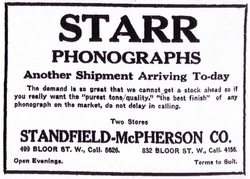
|
|
Starr advertisement for S-M at 499 and 832 Bloor Street West
(TDS Nov. 29, 1919, p. 12)
|
|
|
The business partnership was declared on
October 2, 1919 to "....carry on....business
as wholesale and retail electric
lamps, phonograph
records at Toronto in
partnership under
the name Standfield
Macpherson....
said partnership
has subsisted since
31st March 1919"
(AO Companies
Branch records 8667
CP, reel MS 2054).
We did not find a
record of how these
two gentlemen met
and decided upon the
business partnership.
The phonograph store
at 499 Bloor Street
West first appeared
in CTAR on August
25, 1919 – it was
listed as a cigar store
a year before – and
Standfield-Macpherson
was mentioned as
representing the local
Starr dealers at the
company exhibit at
the 1919 Canadian
National Exhibition
(CMTJ Sept. 1919, p.
76). S-M ran Starr ads
that November (TDS
Nov. 19, 1919, p. 10;
TDS Nov. 22, 1919, p.
14) and on November
29 introduced its
second store, at 832
Bloor West (TDS Nov. 29, 1919, p. 12).
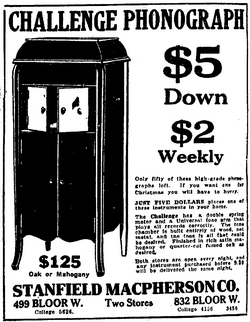
|
|
One of the S-M advertisements for the "high grade" Challenge
Phonograph, obtained to fill demand when Starr could not supply
certain machines for the 1919 Christmas trade (TDS Dec. 18,
1919, p. 12; TDS Dec. 20, 1919, p. 10) Does anyone know who
manufactured and/or supplied the Challenge Phonograph?
|
|
|
Just
before Christmas, when many Starr machines
were unavailable,
S-M ads featured
only the doublespring
Challenge
Phonograph, which
had a universal
tone arm, and could
be delivered that
same night for $5
down and $2
weekly (TDS
Dec. 18, 1919,
p. 12; TDS Dec.
20, 1919, p.10). S-M
was still listed as a
Starr dealer in late
June (G June 23,
1920, p. 7), but 499
Bloor West was in the
process of becoming
the "The Bloor Street
Brunswick Shop"
(TDS June 3, 1920, p.
24), with no mention
of S-M or the second
store. As of August
25, 1920, CTAR no
longer listed S-M at
499 Bloor, but showed
The Brunswick Shop
there, under different
management. Charles
S. Porter, who had
run a phonograph
dealership at 1631
Dundas West in 1919,
was now dealing in
phonographs at the
old 499 Bloor store
(Might’s 1921).
The 1920 Might’s Directory (compiled in late
1919), showed S-M with three stores, at 499
Bloor West, 832 Bloor West and 362 College
Street. A year before, 832 Bloor had been
apartments and then a shoe store, and 362
College dealt in preserves.
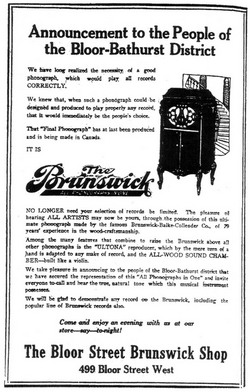
|
|
First announcement of Bloor Street Brunswick Shop, 499 Bloor
West (TDS June 3, 1920, p. 24)
|
|
|
As noted above,
by August, 1920, S-M had left the original
store at 499 Bloor. Then, in December, an
announcement, almost identical to that of June
3, that S-M was now a Brunswick dealer at its
three stores, 618 and 832 Bloor and 362 College
(ET Dec. 9, 1920, p. 20). Months later, they
were still Brunswick dealers at the same three
stores (TDS May 6, 1921, p. 30). In the 1921
Might’s, S-M was listed at 618 Bloor West (a
former butcher shop) and at 832 Bloor West,
now selling "musical instruments" (a general
term which may have included phonographs),
but soon were reduced to 618 Bloor West,
offering a special on Challenge, Brunswick,
Sonora and a used Victor (TDS Nov. 4, 1921,
p. 2). Perhaps the continent-wide economic
downturn of 1921-23 reduced their fortunes
and the number of their business outlets.
All the while, however, though not listed as
dealers in Starr advertisements, 618 Bloor West
remained in the Bell Telephone directories as
“Starr Phonograph Parlors” (Jan., May, Nov.
1921, May, Nov. 1922). Later they were selling
"musical instruments" (CTAR August 15,
1922).
We surmise that Melville lost his Starr
showroom by late 1919, when the Starr Special
Distributing Branch under Mr. E.W. Wood
turned up in room 412 in the Ryrie Building,
229 Yonge, corner of Shuter (CMTJ Dec.
1919, p. 60). A year later, the Branch was in
the Hiscott Building at 61 College Street, under
John Caswell, but the following year it was
at 618 Bloor Street West (G Oct. 17, 1921,
p. 3).

|
|
Advertisement for S-M multi-brand phonograph sale at 618 Bloor
Street West (TDS Nov. 4, 1921, p. 2)
|
|
|
At 618 Bloor, S-M stocked the entire
Starr catalogue, though they were never listed
as agents in Starr ads. Although we found no
explicit indication that the Starr Branch was
being run by S-M, they were the only tenants
of 618 Bloor West (CTAR Aug, 15, 1922;
Aug 17, 1923) and the two businesses shared
the original S-M telephone number, College
5626. Following the disastrous fire at the Starr
warehouse in London (G Apr. 29, 1922, p. 16),
Starr sold off its phonograph stock (TDS May
19, 1922, p. 12) and wound down its operation.
S-M’s business was likely on the downturn
then too, especially when Reg was lured away
to Uxbridge by Gold Medal Radio-Phonograph
Corporation, Ltd. S-M was out of the music
business by the summer of 1923.
The Burrows Music Shoppe (Louis J. Burrows,
a former Willis Piano agent and later Starr
dealer at 920 Queen East) first appeared in
CTAR at 618 Bloor West on August 17, 1923.
The 1924 and 1925 Might’s have the Burrows
Music Shoppe at 618 Bloor, with the Starr
Company of Canada, Ltd., managed by William
A. Dietrich, in the rear, both dealing in "musical
instruments". We do not know whether these
were independent businesses – there is still a
major entrance door at the rear of 618 Bloor
– and whether this incarnation of the Starr
Company dealt in records, or perhaps in Starr
pianos as well.
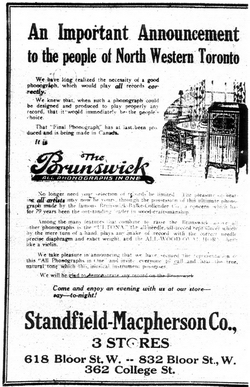
|
|
Standfield-Macpherson announcement of its Brunswick dealership
at its three stores (ET Dec. 9, 1920, p. 20)
|
|
|
According to the 1922 Might’s, Harry C.
Slater had taken over from Charles S. Porter
as phonograph dealer at 499 Bloor, Mrs. Maud
Kennedy was handling musical instruments
at 832 Bloor and the Central Victrola Parlors
was at 362 College. It is intriguing that each
of the four S-M stores remained
phonograph / gramophone shops, under new management,
after Messrs. Standfield and Macpherson
moved on. In 1923, 499 Bloor was a
hardware / electrical store and in 1924 it was vacant. In
1926, both Burrows and Starr of Canada were
gone from 618 Bloor.
Corporate History
From 1919 to 1921, Melville was president of
S-M (ET Mar. 13, 1922, p. 19), Macpherson
the vice-president and Reginald the salesman.
Note that the company name is found variously
hyphenated, unhyphenated and using an
ampersand between the names.
The company applied for a charter of
incorporation or Letters Patent under the
Ontario Companies Act on April 13, 1921, to
take over the business of Standfield Macpherson
Company as Standfield-Macpherson Company,
Limited, with a capital stock of $40,000,
comprising 400 shares valued at $100 each. The
provisional directors were their lawyers Leopold
Macaulay, William Thomas Sinclair and Hugh
Johnston McLaughlin of McLaughlin, Johnston,
Moorhead and Macaulay, 120 Bay Street.
S-M was going to carry on "....business....
as wholesale and retail dealers in musical
instruments, musical compositions and records"
(CB #19074; file 29-20-3-1). Macpherson
was to be president and Melville Standfield
the secretary-treasurer. No explanation was
given for the exchange of executive officers,
nor for dropping the term “phonographs” and
the lightbulb business, though they were still
Brunswick phonograph dealers at three stores
(TDS May 6, 1921, p. 30).
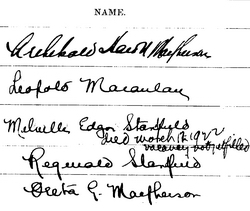
|
|
Signatures of the officers, Letters Patent, April 15, 1921
(CB #19074)
|
|
|
In the company’s Statement or Return of
Affairs, as of December 21, 1921, Macpherson
was president and manager, Leopold Macaulay
was vice-president, Melville was secretary-treasurer,
the directors were Reginald Standfield
and Oreta G. Macpherson, and the address was
618 Bloor West. In the next statement, dated
February 20, 1923, Macpherson was president
and manager, Macaulay was vice-president
and Reginald Standfield had replaced his late
father as secretary-treasurer. The directors
were now Mrs. K(athleen) Miller and Oreta G.
Macpherson.
The Standfield family says that the business
was wound down, but the story retained by the
Macpherson family is that they went broke.
The Companies Branch was informed by
Mr. Leopold Macaulay in 1930 that the
S-M Company last operated in 1923, that Mr.
(Melville) Standfield was dead and that the
charter could not be found (CB letter of August
16, 1930). At this point, neither Macpherson
nor Reginald Standfield could be located by
anyone. Thirty years later, by an order dated
November 7, 1960, the Provincial Secretary
cancelled the Letters Patent "for default in filing
Annual Returns and declared said corporation to
be dissolved on December 12, 1960". The total
fees owed from 1923 to 1960 were $152.00
(CB #19074, file 29-20-3-1; AO MS 508
reel 3).
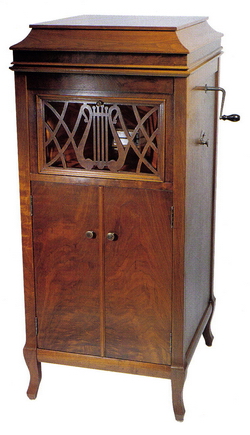
|
|
Starr Phonograph - This is the model seen in the left-hand
window of the store, with its lyre grille removed and set on the
floor in front (photograph courtesy of Timothy C. Fabrizio,
George F. Paul and William G. Meyer)
|
|
|
WHAT BECAME OF ARCHIBALD
HAROLD MACPHERSON
The Macpherson family apparently left Toronto
and rented out the family’s home on Jameson
Avenue in 1924, soon after S-M disappeared,
but Archibald Harold returned in 1930 and
continued to live there in one of three "suites"
with his wife, Oreta, until the middle 1950s.
After brief ventures in real estate and the
cleaning and dyeing business, he became a
clerk in the City Department of Public Welfare
around 1935, was last listed in Might’s in 1960,
still holding that job, but living at 40 Avenue
Road. His wife Oreta died on May 3, 1957, and
the family told us that he retired and moved to
Meaford to live with his sister Gladys in May,
1960. Macpherson died in Meaford, Ontario,
on April 4, 1961 (ET April 5, 1961, p. 40; ME
Apr. 6, 1961, p. 1; FIPPO) and is buried with
his wife, siblings and parents at Mount Pleasant.
WHAT BECAME OF REGINALD
STANDFIELD
Reginald Standfield gave up the family’s
apartment at 310 Brunswick Avenue to live
with his married sister "Kitt" Miller at 38
Howland Avenue by late 1922. Soon after,
he was at 3 Palmerston Gardens, directly
north of the 618 Bloor store. It’s possible
that Standfield-Macpherson was disbanded in
1923 when Reginald received an offer from
the McMurtry family that he couldn’t refuse,
to become factory manager of their new Gold
Medal Radio-Phonograph Corporation, Ltd.,
in Uxbridge, Ontario. There, he supervised a
staff of some 35 workers and was well liked
as the boss. "Despite Reg’s carefree look, he
has been a real 'plugger' ....having worked
from the ground up in the Gold Medal plant,
mastering as he went along many difficult and
technical courses in wood drying, glue practice,
finishing, etc. The Gold Medal state they owe
much to Reg for their present high standard of
finishing...." (CMTJ April 1924, p. 78).
The Standfield family retains a story of the
Uxbridge factory’s water tower being out
of order and Reg asking for a volunteer to
climb up to fix it. No one came forward, so
Reg himself climbed up the ladderless tower
by means of the cross-braces, and fixed it
himself. He had to, because he could not back
away from it. Reg "successfully improved the
profits of Gold Medal over a period of a couple
of years" (personal communication, Gary
Standfield).
Reg married his sister-in-law, Miss Dorothy
Hill Miller of 33 Wells Street, Toronto (TDS
Aug. 18, 1924, p. 19), and then was lured
away from Gold Medal to head the radio
department at the Robert Simpson Company
in Toronto. He moved to Vancouver in 1926
to become manager of the radio department
at the Hudson’s Bay Company, was appointed
assistant manager of the Winnipeg Bay store in
1932, then of the Calgary store and from 1936
or 1937 was manager of the Vancouver store.
In Vancouver, he was the first B.C. chairman
and a national director of the Air Cadet
League of Canada, a member of the council
of the Vancouver Board of Trade, a member
of the Vancouver Club, the Royal Vancouver
Yacht Club, the Vancouver Gun Club and the
Air Force Officers’ Association. He died in
Vancouver in 1950 (G July 17, 1950, p. 11; VS
July 17, 1950, p. 1), survived by his widow and
two sons, Barry and Derek.
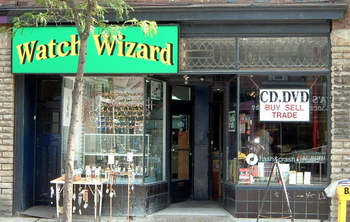
|
|
499 Bloor Street West to-day, divided into two stores (photograph by Bill Pratt)
|
|
|
WHAT BECAME OF THE STORE AT 499
BLOOR WEST
The store at 499 Bloor Street West looks
surprisingly like it did in March 1920. The glass
frieze is intact above the front windows, which
look the same as well.

|
|
Original threshold of little white hexagonal tiles, with "499" and a border inlaid
in blue (photograph by Jan Verboom)
|
|
|
The threshold of little
hexagonal marble tiles,
with "499" and a border
inlaid in blue, is still
there, and the pressed-tin
ceiling is still in
place in the westerly
half. The door to the
upstairs apartments, at
left, looks as it did in
the photograph. The
major change is that the
central front door has
been replaced by two
doors, almost at right
angles to each other,
each giving entrance to
a separate store.
UNANSWERED QUESTIONS
We do not know how the 49 year-old Melville
Standfield and the 27 year-old A. Harold
Macpherson got together to open a phonograph /
gramophone business in mid-town Toronto,
circa 1919. Perhaps young Reginald and young
Harold knew each other from public or high
school, from the Parkdale Canoe Club, from the
Argonaut Rowing Club, from its football team
or from its musical activities.
We do not yet know why S-M originally chose
to combine the phonograph and wholesale light
bulb businesses. We have no evidence for why
S-M expanded quickly, apparently collapsed
just as quickly – perhaps it was a victim of the
explosive advent of radio in 1922 and/or the
depression of 1921 - 1923. S-M seems to have
switched its speciality to "musical instruments",
but gramophone / phonograph stores were
listed in Might’s under "Musical Instruments",
so S-M might have remained in the machine
business at the last store, at 618 Bloor West.
From the ensuing rapid changes in ownership at
the various former S-M stores, the phonograph
competition must have been cut-throat, or the
locations could have been poor.
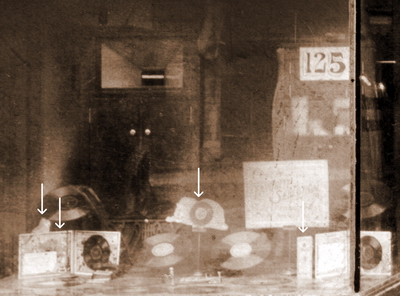
|
|
Detail of S-M store window, left side. Arrows indicate Talking Books "The Battle of the Marne", "The Mocking Bird" and
"I am a Lion", and what may be a Talking Book catalogue at lower right.
|
|
|
All this information came to light from one
fine but uncredited and undated photograph.
We hope that this story illustrates what can be
discovered about almost anything, if one knows
where to find the search tools.
WHAT’S IN THE STORE WINDOW
The Machines
In the left-hand window, we see what looks like
a Canadian Starr Model III machine at rear left,
with its lyre grille removed and on the floor in
front, and an unknown machine to the right,
with a sign reading "125". Perhaps this is the
$125 Challenge Phonograph, as shown in the
newspaper advertisement (TDS
Dec. 18, 1919, p. 12; TDS Dec.
20, 1919, p. 10). The large sign
below reads in part
"....Favorite selection....".
The right-hand window
contains Victor machines
only, a Victrola VV-IV at
lower left, a IX with open lid
in the centre and a VI
at right. In the rear
are two Victrola 14
uprights.
The Records
The identifiable records in the left-hand window
are almost all from the two "Talking Book"
series produced for children by the Emerson
Phonograph Company, Inc., through Talking
Book Corporation in New York and Talking
Book Company, Ltd., in Toronto. They issued
multi-page gatefold books, with one or two
celluloid records glued inside, that could be
flipped open to lie flat and be placed directly
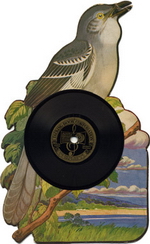
onto a turntable. The other type was a die-cut,
laminated cardboard tablet, a "talking doll" or
"talking animal", with a celluloid record glued
or riveted onto one side and a related poem
or story printed on the reverse. That too was
placed directly onto the turntable for tracking.
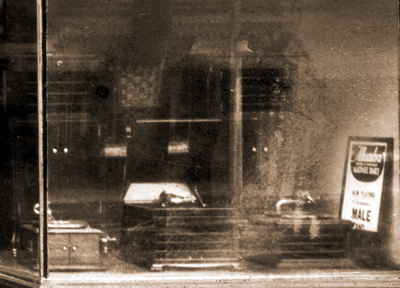
|
|
Detail of S-M store window, right side.
|
|
|
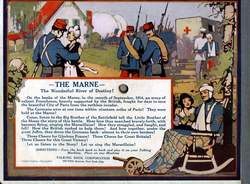
At far lower left is the gatefold "The Battle of
the Marne" and the top of the laminated die-cut
"Mocking Bird" can be seen above and behind
it. Mounted on a pedestal at centre is a light
blob with a disc record in its centre, and this
is the "I Am a Lion" "talking animal". David
Lennick can identify a real U.S. Gennett disc
immediately above "The Battle of the Marne"
book (personal communication). Other records,
mounted like cymbals on short poles, cannot be
identified for certain nor can the several records
visible on the floor of that window. We believe
that the 10 inch-tall sheet standing just to the
left of the unidentifiable gatefold at far lower
right, may be a rare "Talking Book" catalogue.

|
|
Talking Book Corporation’s "talking animal", "I am a Lion" (courtesy of Peter Muldavin)
|
|
|
SOURCES:
AO - Archives of Ontario
CB - Companies Branch, Ministry of
Consumer and Business Services, Suite 200,
393 University Ave., Toronto; #19074; file 29-
20-3-1
CMTJ - Canadian Music Trades Journal,
Fullerton Publishing Co., Toronto
|
|
Talking Book Corporation’s gatefold, "The Battle of the Marne". Details such as the gabled roof (upper left)
and the rocking chair (lower right) are quite visible in the original photograph (courtesy of Peter Muldavin)
|
|
|
CTAR - City of Toronto Assessment Records,
Metropolitan Toronto Archives, Spadina Avenue
DT - Daily Telegraph, Sydney, Australia
ET - Evening Telegram, Toronto
FIPPO - Freedom of Information and
Protection of Privacy Office, Ministry of
Government Services, 34th floor, 250 Yonge
Street, Toronto
|
|
Talking Book Corporation’s "talking
animal", "The Mocking Bird", approx.
10" x 6.5" (courtesy of Peter Muldavin)
|
|
|
G - The Globe, Toronto
KWS - Kingston Whig-Standard
ME - Meaford Express, Meaford, Ontario
TDS - Toronto Daily Star
TMW - Talking Machine World, New York
UT - Student transcript, Faculty of Arts and
Science, University of Toronto, reel #89, A89-
0011
VS - Vancouver Sun
Thanks to Gary
Standfield, Lachine, Dr.
Hugh Standfield Miller,
Vancouver, Barry and Derek
Standfield, Vancouver, Mrs.
Grace Williams of Kingston,
Mrs. Glenna Voorneveld of
Brockville, Mrs. Kathryn
Spencer-Lee of Belleville,
David Lennick of CAPS,
Andrew McMurtry of
CAPS, Jan Verboom of
Pickering, George McCauley
of the Argonaut Rowing
Club, Mr. John Maize of
Parkdale Collegiate, Sally
Gibson and Elizabeth
Cuthbertson of Metro
Toronto Archives, Maria
Kouroupis of Sicon Sign of
Vancouver, Scott Woodhouse,
Editor of the Meaford Express,
the Royal Conservatory
of Music, and Bill Pratt of
CAPS for technical help and
advice. Special thanks to Peter
Muldavin, whose book "The
Complete Guide to Vintage
Children’s Records" will be
published in December.
Copyright © Arthur E. Zimmerman and
Betty Minaker Pratt
|