|
45s1s54 Part 2
by Keith Wright
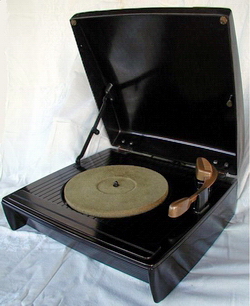
Columbia clam shell LP player
|
|
Software Medium: Speed Limits
On the first record-playing machines, keeping a
constant speed was impossible as they were rotated by
hand. If you listened closely, going slower made the
sound last longer but made it sound worse.
Spring-drive of course helped standardize speeds. I've seen
one suggestion that from 1894 to around 1930, record
speeds ranged from 65 to 90 rpm. Another source
suggests that standardisation began in 1912, when one
company conducted listening tests on their back
catalogue and settled on the average (or possibly the
median) of these tests, which turned out to be 78 rpm.
Other companies adopted this, but the process was not
complete until the early 1930s. There was another
curious story that suggested Victor used 76 rpm for
many years but instructed buyers to play back at 78
rpm improving the record's durability. Whatever the
case, 78 rpm became-seemingly by default-the first
disc speed standard.
Then along came film-as in moving pictures.
Apparently (and you can try this at home-if no one else
is listening) if you play a standard 12 inch 78 at 33 1/3
rpm. It lasts for about 10 minutes (although your
interest in it lasts much less). Co-incidentally, a reel of
film from the early 'talky era' lasted approximately
10 minutes (1,000 feet of film). American Vitagraph (via
Bell labs) took these seemingly disparate facts and put
them together to make talking pictures using discs -
records and reels were changed at the same time to
keep the film's visuals and sound in synch. Suddenly I
have that scene from Singing In The Rain in my head
("It goes through the wire and ends up on the record.
Now SILENCE!"). Actually, the 33 1/3 fell out of the
work by Maxfield and Harrison of Bell Laboratories,
part of which showed that it was a convenient speed
approximately one-half of 78 that could be easily
locked to the 60-hertz line. It has been suggested that
Columbia just 'dusted off' a transcription disc turntable
(this format is mentioned in Part 1 under 'material’)
from RCA and they used that speed for the LP.
And-of course-78 minus 33 equals 45. [Ahem.]
Actually, I have three stories for why the 45 turns at that
speed. In the first, "The 45 rpm speed was the only one to
be decided by a precise optimisation procedure (by
RCA Victor in 1948). Calculus was used to show that the
optimum use of a disc record of constant rotational speed
occurs when the innermost-recorded diameter is half the outermost-
recorded diameter. That's why a 7-inch single has a
label 3 1/2 inches in diameter. Given the CBS vinyl
groove dimensions and certain assumptions about the
bandwidth and tolerable distortion, a speed of 45 rpm
comes out of the formula." (Quoted from Copeland-
although the research actually sounds like the work
done by Maxfield et al at Bell Labs not RCA.)
In the Second story, "J. P Maxfield analy[zed] the
compromise between signal-to-noise ratio and came up
with 33 1/3... Maxfield's analysis still applies: the 45
'single' was RCA's equivalent to a 10-inch, 78 rpm
record, only smaller." (Brack-Nanestad)
The third story holds, "RCA Victor came up with a 7-
inch vinyl disc with microgrooves, rotating at 45 rpm,
a speed chosen specifically to make the most of the
music, unlike 78s or 33 1/3s." (Worsley)
(Much of the above is from: Peter Copeland, British
Library National Sound Archive London; George
Brock-Nannestad; Roger Worsley; and Journal of the
Audio Engineering Society, October/November 1977,
Vol. 25, Number 10/11.)
So, in 1948 Columbia brought out the microgroove LP.
It was made of Vinylite and spun at the transcription
disc speed of 33 1/3. Here are three of my favourite
quotes regarding the LP:
"Wallerstein, anticipating the need, was smart enough
to make a deal with Philco to put out a player for
$29.95 which they lowered to $9.95. For $29.95 you
got the player and three LP's which were $4.95 each.
They were using the Gillette razor method - virtually
giving the player away to get people to buy the
records."
"When you took into account the playing time per disc,
LPs were cheaper than 78s. The typical recording of a
symphony on LP cost about half what it had on 78s.
Customers paid less and got more. No wonder the LP
was one of the most successful product launches in
history. And just think: there probably wasn't a single
MBA involved. " Sam Tellig, February 2001.
"Though the Columbia record was introduced on June
21, 1948, at the Chicago Radio Convention, it wasn't
until 1950 that most of its problems were solved. It
succeeded not so much because it was revolutionary
but because it worked and was wisely marketed with
an 'inexpensive' and widely available player." Martin
Mayer, January 1958.
The well-told story is that General Sarnoff, now in
charge of RCA, was invited to Columbia. As Edward
Wallerstein (one of the developers of the LP) told it:
"In April 1948, two months before the LP's first public
showing, Paley [William S. Paley, president of the
Columbia Broadcasting System] called David Sarnoff,
of RCA and told him that we had a new development
in the record field that we would like very much for
him to see. A meeting was arranged in the boardroom
of CBS, and I demonstrated the LP. Not much was
said, but I did have the impression that General Sarnoff
was pretty upset. In the silence that followed, Paley
said he'd be glad to discuss an arrangement for
licensing...In fact there are no basic patents on the LP,
so RCA was forced to do its own research.
They came back to us in a few days and said they weren't
interested and I think it was a bit of a blow to Paley
that he wasn't going to make a lot of money in
licensing." Sarnoff's professional pride apparently
suffered and it has been reported that he had later said
such things as, "How could little Columbia with a two-
by-four laboratory, beat RCA?"
(Remember this little tid-bit. The Columbia Vinylite
record could have been any colour at all.
It could also have been clear - think, Vogue record. The 78 was black
because the addition of lamp black increased the life of
the record-supposedly reducing wear. Columbia made
LPs black to calm the suspicious consumer.
'See, it's just like a 78!")
RCA immediately rushed a new format into production
the next year in direct competition with Columbia.
Right? Well, no. We have to go back to the 1930s
again!
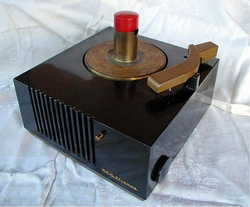
9-EY-3 table phonograph - one of the original 1949 RCA players
|
|
Impetus for change: Why is the hole so big in the 45?
I think it's safe to say that the length of the popular
song has been affected by the consumer recording
industry. Of course, putting an opera across a gazillion
78s, and having a fade out in the middle of a symphony
movement-puts classical music at the opposite end of
the spectrum. To save the lover of classical music from
wearing out the carpet, companies started adding
changers to their electric 78 players.
I have seen sources indicating that Bill Carson was
responsible for the design of all RCA record changers
up to and including those of the early 45s, starting in
1927 when he was at Victor. Recently there has been
an amusing discussion on one of the Internet
phonograph groups about the 'Rube Goldberg' early
RCA changers. These beasts (such as the Type I, Type
IT and to a lesser extent the changer in the "Magic
Brain" machines) can provide as much entertainment in
watching the record change as in listening to the music.
And one enthusiast likens servicing such monsters to
servicing an early automobile! The RCA changers
worked well with RCA records but unfortunately there
was no standard for the size or thickness to the shellac
78. This has been cited as the reason why not all
changers worked well with all records.
One changer has been called, "The best available
delaminator of Columbia records ever invented."
Another was described as, "Systematically
discriminating against Victor records cracking them
neatly." And further, "The weight of 78s on the spindle,
and different thicknesses and edges
of the discs broke down the drive and separator mechanisms. The
drawbacks helped give changers the worst reputation
among RCA Victor products." (after Alexander
Magoun)
Somewhere between 1934 (what a coincidence) and
1939 RCA turned again to Bill Carson and challenged
him to come up with the killer changer - reliable and
fast. Carson's reply essentially was, "OK. But you'll
have to change the record." It has been called the best-
kept industrial secret in the history of consumer
electronics. RCA embarked on the 'X-project' to
develop a new record and changer. (In order to protect
the patent life of the system components, the project
became the only secret consumer technology project in
RCA's history.) Magoun (In Phil Vourtsis' The
Fabulous Victrola 45) does a good job of tracking the
development of the X-record and how it got stalled
within the bureaucracy of RCA with the marketing
department at one point being unaware
of its existence.
Another of my exciting finds doing this research was a
series of pencil and watercolour studies done by the
RCA design studios in 1943. The machines they render
clearly have the thick spindles of the 45 format, or at
least, of Carson's changer for the X record.
(One of these pictures is on page 5 of the
November-December APN in Part I of this article.)
In 1948, with Columbia threatening to take the lead on
a new format that would finally replace the 78, RCA
had to make a decision. Go with Columbia? Hardly.
Corporate pride would not allow it. Come out with the
new changer and run at 78? Go with the whole new X
record player and format? It has been called the last
time that the engineers won at RCA. Carson's changer
would be launched with a microgroove record spinning
at 45 rpm. (The original players were the 9-JY
phonograph attachment and the 9-EY-3 table
phonograph. Carson's X-changer was dubbed the RP-
168 changer or chassis.) But the marketing department
had finally woken up and had a hand in what RCA did
to the record.
The 45 rpm record's large centre hole was made to
accommodate the spindle of the new changer.
One of Carson's objectives for the changer was to eliminate
the ‘arm’ to hold the record steady. The only way to do
that was to have a diameter big enough to stabilize the
weight of the record. You can't do that with a tiny 78
(and LP) centre hole. (Another of Carson's objectives
was to have the change cycle occur in one revolution.
That is why the changers are so quick.)
As noted previously, Columbia with a clean slate had
the opportunity to change the colour of the record
when the vinyl LP was introduced but tried to make
consumers feel 'safe' with the traditional black. RCA
on the introduction of the 45 brought out a veritable rainbow
of vinyl. They made it easier to tell the musical style
on the record just by glancing at it. There were:
- Classical records in red-after the 'Red Seal label, I suppose.
- International records in sky blue-for all of the nations under the sky?
- Light classical records in (romantic?) midnight blue.
- Country records in green - for the grass of the country?
- Popular records in the traditional black.
- Children's records in eye-catching bright yellow.
- R&B and Spirituals in ugly orange.
Oops, the salesmen were supposed to sell the R&B as
'cerise' vinyl, not orange. The RCA colour description, I
guess, makes sense for all of those singers who ‘woke
up this morning' and thought life was the pits. Cerise is
by far the scarcest record colour, with early records
regularly fetching $60US, when they are available.
Of course the realities of the production line - where
work had to be stopped, the colour cleaned out and the
next colour started - put a quick end to the colours. Red
and especially yellow hung on a little longer (yellow
kids’ records being available from other labels). The
colours also tended to bring an aura of 'cheapness' to
the 45 at this crucial time. RCA was now in a battle for
the ears and wallets of music lovers with Columbia and
with the dead-format-walking, the 78.
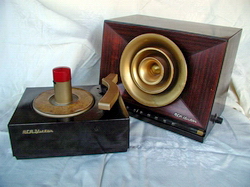
45-J-1 RCA attachment from 1950 (essentially, a re-branded 9-JY from 1949) and contemporary radio (9-X-571 'bullhorn’)
|
|
Finally: The Phony War to R.I.P.
The date generally cited for launch of the RCA 45 is
March 31, 1949. Some cite an earlier date, but prior to
this the RCA Distributor's Record Bulletins had only
records with number starting with 20, 21 and 22.
They were all 78s! There were no 45s available for
some weeks yet! The period right after release and up
to the RCA 'capitulation' (with RCA's acceptance of
the LP in January, 1950) is generally called "The War
Of the Speeds' but I call it a phony war. Both formats
would remain healthy well into the 80s. Each had a
niche, but it may have taken some executives a while
to realize this.
RCA seems to have hit a 'speed bump’ early in the war
until it realized that 45s were not for multi-record
classical albums mimicking those of the 78 era, they
were selling more to listeners interested in single
songs. Younger people in particular were more
interested in spending less to hear just their 'hits' on
cheap players. This swing is evident to me by the three
players available from RCA in the second year of 45
production.
In 1950, there were three players available that did
exactly the same job:
- The original 9-JY radio attachment (I hear that those
over 50 may also remember using the TV) of 1949 was
re-branded the 45-J-1 in 1950. This had Carson's
original X-changer (RP-168) with a number of brass
parts.
- The 45-]J-2 attachment was new from the ground up.
It sported a brand new changer (RP-190) with more
plastic parts and was built by a third-party, Crescent.
- The 45-J-3 was ALSO a new attachment built from
the ground up. It sported yet another brand new
changer with brass parts (RP-193) and it was also built
by a third-party, Oak. The J-3 is the most interesting
looking 45 player RCA marketed (other than the
Berkshire attachment). It has a swooping metal tone
arm and more interesting ‘cosmetics’. It is not the
‘appliance’ the J-2 appears to be.
Some suggestion has been made that RCA over-
anticipated demand for the 45 and had 3 players
available. The demand wasn't there, so only one of
these players lived beyond 1950. Then again, my
Biology background suggests a more Darwinian
subtext. The J-3 is more classy and likely more
expensive to build. RCA just ran out its over-stock of
RP-168 players, contracted out to a third party to cut
costs and when the 45 found its niche with younger
folk with less money, the cheap J-2 survived the
extinction. I will later suggest that this lesson was lost
on record manufacturers during the CD era.
Briefly the evolution of the RCA player is:
- As noted, the original 1949 player model numbers started with '9".
- In 1950 they changed to '45' and the 'E' line was
moved down a notch with the 9-EY-3 being replaced
by the 45-EY-2 while the 45-EY-3 received a lid.
- In 1955 models started with '6' and included a
number of cost-cutting measures. This was also the
year that Carson's new single-play model was
introduced, the Slide-O-Matic, which accepted the
record through the front.
- In 1956, models starting with '7' and '8' sported
better sound through ceramic cartridges, beefed-up
amplifiers and-in some cases-separate woofer and
tweeter speakers. The new players of 1956 should be
avoided, as they are the result of even more cost-
cutting measures and have been "regarded as
downright cheap". Clearly, profits were going down for
machines to play only 45s.
The 78 was dead. In its place survived the LP to fill
the niche of the 78 album and the 45 for the niche of
single 78 sales. In the 1950s the Voice Of Music
Company (V-M) designed the model 900 changer. It
was robust, cheap to build and handled all speeds.
Manufacturers from RCA to Columbia to Zenith
essentially gave up making their own changers and the
V-M (with later variations) was in "every American
made records changer made from the late 1950s to the
end of the American consumer electronics industry,
sometime in the 1970s. At which point the [British],
Germans and Japanese [not to mention the Swiss] took
over the market."
In 1958 there was a fire in the Crescent Chicago
factory. Since there was a plethora of 3 speed (and
more) changers on the market, it made no sense to
rebuild and resume production of the 45-only player.
RCA 45 Player
R.I.P. (1949-1958)
"Collectible" 45 Players
Phil Vourtsis' book is the place to go for details of each
model (especially RCA) and a rough 'price guide’.
The following is my "Cook's tour" of this material.
RCA 45 players can be categorized by their underlying
chassis (the changer-remember that?):
- The very first players (9-EY-3x and 9-JY of 1949)
had Carson's original X-changer, the RP-168. It is
identified by its brass platter, tone arm and spindle.
The most unusual RCA machine must be the CP-5203
(sporting the RP-168) with its cherry-wood case and
brass hardware intended to convert the RCA 'Berkshire'
monster entertainment centres (like the $4,100
Breakfront that weighed in at 7151b with 69 tubes!) to
45 players.
- The RP-168 was all but abandoned in 1950 for the
RP-190 chassis (45-EY-x, 45-2, etc. of 1950, through
the 6-x units of the 1955 revision to the 8-EY-31x of
1957) built by Crescent. The 190 is identified by the
plastic tone arm, platter and spindle. Obviously the
RP-168 machines are fewer in number. The 45-EY-3 (a
‘downshift’ turned the 9-EY-3 into the 45-Ey-2) is a
lidded machine with above-average styling mistakenly
called 'deco’ that commands a few dollars more than
most RP-190 machines.
- Even more rare is the 45-J-3. As noted above,it was
made only in 1950 and was the only model with the
RP-193 chassis. This machine is quite distinctive with
its swooping tone arm.
- Carson's last technical 45 hurrah was, of course the
RP-199 'Slide-O-Matic' brought out in 1955.
These machines required the record to be inserted in much the
same way as a CD in some players of today. They don't
change at all! Those versions with radios generally
command twice the price of plain ones. (And the clear
one likely commands a price similar to that of a clear
Panasonic Plunger 8-track player. I thought you really
needed to know!)
Higher prices are generally commanded for those
machines with extra ornamentation. These include the
Disney (3 versions), Roy Rogers and Ding Dong
School (based on an early 'educational' TV show)
models. And who can forget the 7-EP-45 with the
signature in gold of some kid named Presley?
I don't generally look for anything for its 'collectible'
cachet - I'm more interested in design. Through
licensing, RCA made the 45 technology available to
other manufacturers. In my eyes RCA was trumped by
more interesting machines from Emerson, Crosley,
Zenith and even Crescent(!).
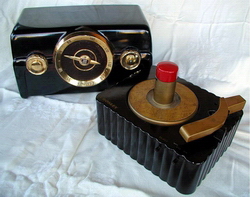
1950 Crosley 45 attachment
and contemporary 10-138 radio.
Crosley, Motorola and Zenith marketed the
same player based on the RP-168 - better
looking than the RCAs!
|
|
Caveat Emptor
So for 15 bucks you just picked up a 45 player, eh? Now you'll,
go home and plug it in. If it plays, please immediately run out and buy
a lottery ticket! Boy, are you lucky today! Remember, |
was nearly fried by my first player. Here is why yours
likely won't play (it also shows why working players
demand the prices they do):
- The crystal cartridge is dead. Rochelle salt crystals,
used in the first players, are heat and humidity
sensitive. Also, the cartridge was expected only to have
about 10 hours of playing time in it. You can try to
mount a modern, low cost cartridge yourself (from say,
Ed Saunders) or go for a "Low Rider’ (from William
Bosco) that essentially 'plugs right in'. (Maybe $35 US for parts.)
- The tubes are dead. Sorry, you can't run down to the
local store's tube-tester any more and then pick out a
replacement (I can remember my Dad doing this!). If
you can't do it yourself you need to have some
refurbishing done by an expert. Sorry, I won't divulge
my repair source as I need him to work on MY
machines before he retires - and he's long overdue
already. (Maybe $75 - which includes the labour for
other problems on this list.)
- Idler wheel and/or cycling cam is too hard or even
melted (one of mine was!). If this is the case, when the
changer cycles, the unit may stop dead. The turntable
also may run slow. You can try to 'get a grip' with
lacquer thinner or other chemical, but it's best to get it
replaced/retired. ($10 US for a kit or $30 US for a
completely rebuilt wheel, with trade in.)
- The motor may be bouncing up and down and/or
unable to get a grip on the wheel. You need your
rubber motor mounts replaced. ($5 US for 6-9
depending on supplier.)
There is a list of US resources at the back of Vourtsis'
book. To it I will add Ed Crocket (phoned@aol.com)
for wheels and motor mounts; Ed Saunders
(www.ewsaunders.com) for replacement cartridges (the
power point conversion kit-newly made by Pfanstiehl-
worked nicely on my 63-E); and Dave Cantelon's Just
Radios for Canadian electric phonograph schematics to
facilitate repair (their web page for thisis
http://www.geocities.com/justradios/phonos.html).
If you have any Canadian contacts for any of this stuff, please share!
Final Word
Cylinder vs. disc, Beta vs VHS, 4-track vs 8-track, then
8-track vs audiocassette. The 45 was the same, right?
Well, yes and no. The 45 still lives. In 1998 (the last
year I have of reliable data) more than 2 million were
pressed. Jukebox owners can't be the only ones to give
the label 'Collectibles' the clout to insist record
companies continue 45 production. Downstairs
Records has 45s for sale on their website from 98
Degrees, Aaliyah and Christina Aguilera-all artists of
the 21st century-alongside of those by that Presley
character. (Apropos of nothing at all, you can also buy
8-track tapes made in the 21st century! Stop laughing.
More on this at a later date.) It might be more
appropriate to say it was LP vs the CD as only now are
the record companies remembering the lessons of the
‘phony war".
In 1949 and 1950 LP and 45 were supposedly going
after the same market. They co-existed for essentially
40 years because they weren't in the 'same space’ at all.
The 45 record was taken up by the younger consumer
because they could save by buying the songs they
WANTED to hear without buying a whole-and more
expensive-album containing 'filler' (a nod must also be
made to the established Jukebox base with the same
need). The CD replaced the LP (which had replaced
the 78 album). A half-hearted attempt was made to
produce the CD single, but it was too little too late
(and way too expensive!). With the advent of computer
music files, techno-savvy young people could once
again hear just the songs they wanted. File-sharing
services filled the void left by the record companies
adding the issue of copyright protection (and
unfortunately, fuelling the perception of free music).
Just this week as I finish off this article new pay-by-
song services were announced. So now we have
Microsoft Media Player vs Real Audio vs MP3 vs
AAC. Some things never change.
The 45 lives (as does the spirit of the single 78)-it's just
that they don't all spin anymore! And remember, it all
started with Junior.
|